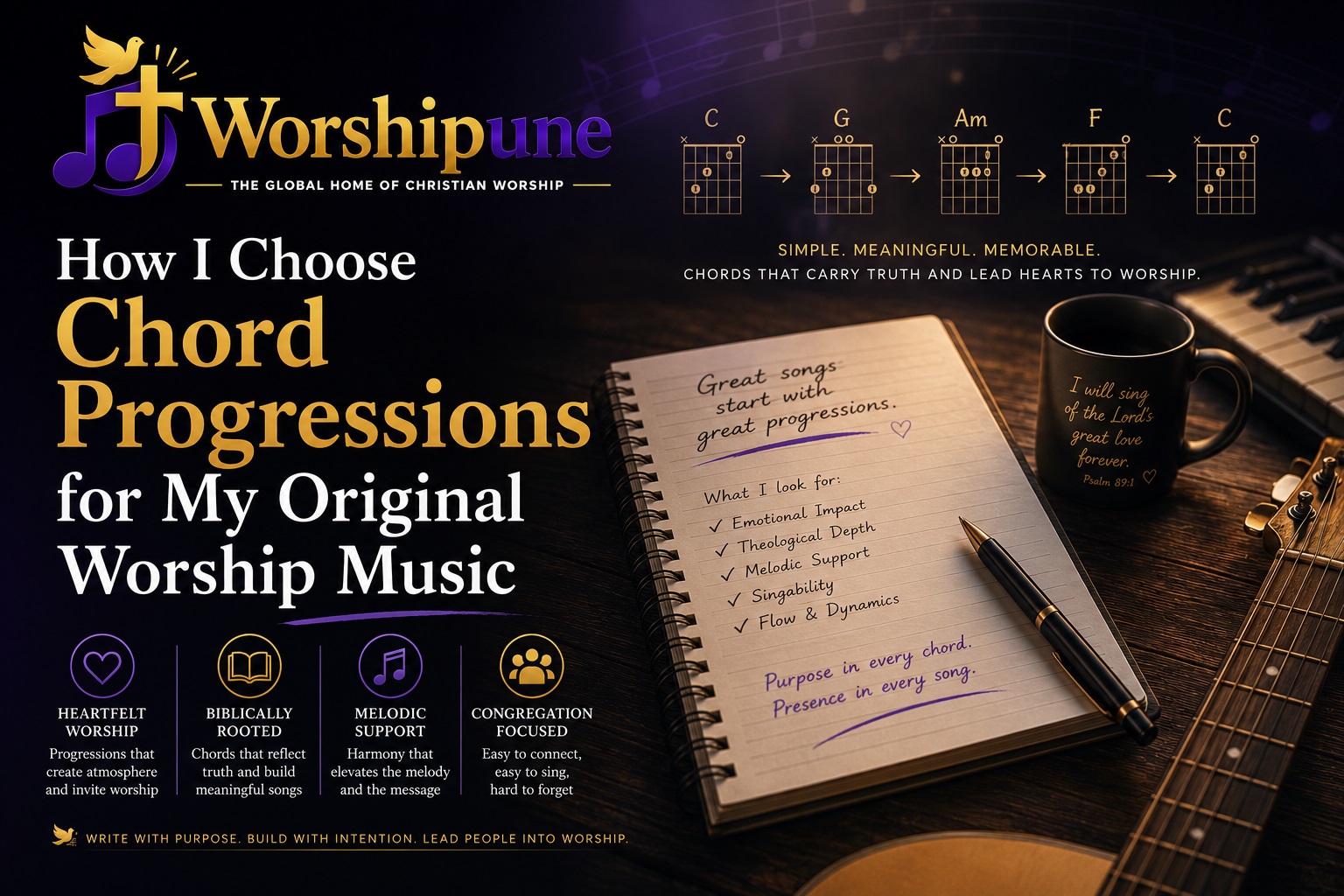
How I Choose Chord Progressions for My Original Worship Music
I used to believe that great worship songs required complex chord progressions. I spent hours studying jazz theory, trying to incorporate diminished chords, secondary dominants, tritone substitutions, and modal interchange into my worship music. I thought the more sophisticated the harmony, the more “anointed” the song would feel. I thought that if I could impress other musicians with my harmonic knowledge, the congregation would somehow sense the depth and be more moved. I was completely wrong. Some of the most powerful worship songs I have ever written — and some of the most powerful worship songs ever recorded by artists far greater than me — use four simple chords. The secret is not complexity. The secret is choosing the right chords for the right emotional moment, and then getting out of the way so the lyric and melody can do their work. The chords are the foundation. The lyric and melody are the house. A fancy foundation with a weak house is still a weak house.
In this article, I am going to show you exactly how I choose chord progressions for my original worship music. This is not a music theory textbook filled with technical jargon that intimidates beginners. This is a practical, hands-on guide from someone who writes worship songs every single week using simple, accessible chords that anyone can play. If you are a beginner worship songwriter who feels intimidated by theory, or an experienced musician who wants to simplify your approach and focus on what actually matters, this is for you. I am going to give you my exact toolkit, my decision-making process, and the progressions I use most often. By the end of this article, you will have everything you need to start writing worship songs with confidence.
My Core Philosophy: Chords Serve the Song, Never the Other Way Around
Before I dive into specific progressions, I need to share the philosophy that guides every chord choice I make. It is simple, but it took me years of overcomplicating things to truly embrace it: the chords serve the song. The song does not serve the chords.
What does this mean in practice? It means I do not choose a progression because it is impressive. I do not choose a progression because it is trendy or because I heard it on the latest worship album. I do not choose a progression because it shows off my musical knowledge or my technical skill. I choose a progression because it helps the listener feel the lyric more deeply. If a I-IV-V progression does that better than a ii-V-I with tritone substitution, I use the I-IV-V every single time. There is no shame in simplicity. There is only shame in choosing complexity for complexity’s sake.
This philosophy is incredibly liberating. It frees me from the pressure to be clever. It allows me to focus on what actually matters: creating a musical environment where people can encounter God. The chords are the room. The lyric and melody are the conversation. The room should be comfortable, warm, and inviting — not distracting, cluttered, or pretentious. A simple room with a powerful conversation is infinitely better than a ornate room with a shallow conversation.
I also believe deeply that simplicity creates accessibility. A congregation full of non-musicians does not care about your harmonic sophistication. They do not know what a secondary dominant is. They do not appreciate your clever use of the Neapolitan chord. They care about whether they can sing along. They care about whether the music helps them pray. They care about whether the song creates a space where they can meet God. A simple progression that everyone can feel is more powerful than a complex progression that only musicians appreciate. This is not dumbing down. This is wisdom.
The Four Chords That Changed Everything for Me
There are four chords that form the backbone of about 70% of my worship songs. They are not secret. They are not proprietary. They are not my invention. They are the most common chords in Western music, and they are common for a reason: they work. They have worked for centuries. They will work for centuries more. Here they are in the key of C major:
C – Am – F – G
In Roman numerals: I – vi – IV – V
This progression has been used in thousands of worship songs, from ancient hymns to modern anthems. And it works because it creates a perfect balance of stability and movement. The C chord (I) is home. It is the foundation. It is where we start and where we want to return. The Am (vi) adds a touch of melancholy or introspection. It creates emotional depth without losing the overall major feeling. The F (IV) creates a sense of departure, of moving away from home to explore new territory. The G (V) creates tension that resolves back to C. It is a musical breath: inhale, hold, exhale, rest. It is the heartbeat of Western music.
When I am writing a song about God’s steadfast love, I often start with this progression. It feels warm and reassuring. It feels like a hug. When I am writing about surrender, the movement from C to Am captures the vulnerability of laying something down. The F to G build creates the sense of being carried forward into God’s purpose. When I am writing about hope, the return from G to C feels like coming home after a long journey.
I cannot tell you how many songs I have written using just these four chords. “Closer Than My Breath” uses a variation of this progression. So does “Even Here.” So does “You Are the Same.” So does “In the Quiet.” The chords are simple, but the songs are not simple. The simplicity of the harmony allows the complexity of the lyric and melody to shine. It is like a simple frame that showcases a beautiful painting. The frame does not compete with the painting. It elevates it.
The Worship Progression: I – V – vi – IV
Another progression I use frequently is what I call the worship progression, popularized by countless modern worship songs and for good reason:
C – G – Am – F
In Roman numerals: I – V – vi – IV
This progression has a different emotional quality than I-vi-IV-V. It feels more driving, more anthemic, more declarative. The movement from C to G is strong and confident. It feels like a step forward. The drop to Am creates a moment of reflection and vulnerability. The rise to F creates anticipation. The return to C feels like coming home, but coming home changed. Coming home after a battle. Coming home with a story.
I use this progression for songs that are celebratory and corporate. If the central theme is victory, resurrection, the greatness of God, or the joy of salvation, this progression often feels right. It has a forward momentum that makes people want to stand up and sing. It is the progression of declaration. It is the progression of the anthem. It is the progression of the shout.
One of my songs, “Rise and Sing,” uses this progression in the key of G: G – D – Em – C. The song is about the resurrection of Christ, and the progression’s natural drive matches the energy of the lyric perfectly. When the congregation sings the chorus, the chords push them forward. It is not the chords doing the work alone — it is the combination of lyric, melody, and harmony working together in beautiful synergy. The chords provide the energy. The melody provides the hook. The lyric provides the truth. Together, they create worship.
The Intimate Progression: vi – IV – I – V
For songs that are more intimate and personal, songs that feel like a whispered conversation rather than a corporate declaration, I often use a variation that starts on the minor chord:
Am – F – C – G
In Roman numerals: vi – IV – I – V
Starting on the minor chord changes the emotional entry point completely. Instead of beginning with the stability and brightness of the tonic, you begin with a sense of longing, searching, or vulnerability. This is perfect for songs about seeking God, crying out in prayer, expressing brokenness, or walking through a dark valley. The progression then moves through F to C, creating a journey from longing to finding. The G chord at the end creates a gentle tension that resolves back to Am, giving the song a cyclical, prayer-like quality. It feels like breathing. It feels like a conversation that continues.
I used this progression for a song called “In the Quiet.” The song is about meeting God in silence and solitude, away from the noise of the world, and the minor-start progression creates the exact right emotional atmosphere. It does not feel like a stadium anthem. It feels like a whispered conversation in a candlelit room. It feels like prayer. That is exactly what the song needed. If I had used the worship progression for this song, it would have felt wrong. The chords would have fought the message. The song would have been confused about what it was trying to say.
How I Choose a Key for Congregational Singing
The choice of key is just as important as the choice of progression. A great progression in the wrong key will cause the congregation to drop out. They will stop singing and start listening. They will feel like the song is happening to them rather than with them. I follow a simple but non-negotiable rule: the melody should sit between A below middle C and D above middle C for the congregation. That is roughly a range of a ninth — comfortable for most untrained singers, accessible to men and women, and sustainable for a full worship set.
When I write a song, I usually start in whatever key feels natural on my instrument. I am a guitarist, so I often start in G, C, D, or E because those keys feel good under my fingers. Then I test the melody by singing it in different keys. I ask: Where does the highest note of the chorus sit? If it is above a D, I lower the key. If the lowest note of the verse is below an A, I raise the key. I want the congregation to be able to sing the entire song without straining, without cracking, without dropping into falsetto.
For male-led worship, I often settle on the keys of G, A, or B. For female-led worship, D, E, or F often work well. But these are just starting points. Every song is different. Every congregation is different. The only way to know for sure is to test it with real people. I have had songs that I thought were perfect in G that worked better in E when I tested them with my church. I have had songs that felt great in D that needed to be lowered to C for the congregation to engage fully.
I also consider the chord shapes on my instrument. If a key requires me to play a Bb barre chord on guitar for the entire song, and I am leading acoustically without a full band, I might choose a different key that allows for open chords. The worship leader’s ability to play confidently affects the congregation’s ability to sing confidently. If I am struggling with the chords, the congregation will sense it. They will hold back. Choose a key that serves both the singer and the player.
Adding Color Without Adding Complexity
Once I have a basic progression that serves the song, I sometimes add color chords to create emotional nuance and depth. But I am careful. I do not add complexity for complexity’s sake. I do not add color just to show that I know music theory. I add color only when it serves the lyric. Every chord must earn its place.
Here are the color chords I use most often, and the emotional effects they create:
The sus2 and sus4 chords: Instead of playing a standard C major, I might play C sus2 (C – D – G) or C sus4 (C – F – G). These create a sense of openness, longing, and unresolved tension. I often use them in verses to create anticipation before resolving to the major chord in the chorus. The sus chord feels like a question. The major chord feels like the answer.
The add9 chord: A C add9 (C – E – G – D) has a beautiful, airy, hopeful quality. It feels like light breaking through clouds. It feels like a new beginning. I use it in choruses about God’s promises, the beauty of creation, or the hope of redemption. It adds sparkle without adding weight.
The 6 chord: A C6 (C – E – G – A) has a warm, settled, homey feeling. It feels like coming home after a long journey. It feels like resting in God’s presence. I sometimes use it in final choruses or outros to create a sense of peace and completion. It is the musical equivalent of a deep breath.
The relative minor substitution: Instead of moving from C to Am, I might move to F major and then briefly touch Dm before resolving. This creates a moment of melancholy that can be powerful in songs about struggle, waiting, or the valley season. The minor color adds depth to the major key without changing the overall tonal center.
I never use more than two or three color chords in a single song. The goal is subtle enhancement, not harmonic showmanship. If the color chords become the main event, the song has lost its focus. The color should be like seasoning in a meal — enough to enhance the flavor, not so much that it overpowers the dish.
The Power of the Pedal Tone
One of my favorite techniques is the pedal tone — holding a single bass note while the chords change above it. This creates a sense of continuity, grounding, and unshakeable foundation. In the key of C, I might hold a C in the bass while the chords move C – Am – F – C/G. The constant C in the bass ties everything together. It creates a thread that runs through the entire progression.
I use pedal tones in songs about God’s unchanging nature. The unchanging bass note becomes a musical metaphor for God’s faithfulness. Even when the harmony moves and shifts, the foundation remains the same. It is a simple technique, but it carries profound theological weight. The congregation may not know what a pedal tone is, but they will feel the stability. They will sense the unmovable foundation. That is the power of musical metaphor.
Writing in Minor Keys for Depth and Longing
Not every worship song needs to be in a major key. Some of the most powerful moments in worship happen in minor keys. Minor keys create tension, longing, depth, and honesty. They are perfect for songs about lament, repentance, the dark night of the soul, or the struggle of waiting. A minor key song in the middle of a major-key worship set creates contrast that makes the celebration feel more celebratory and the hope feel more hopeful.
My favorite minor key progression is:
Am – F – C – G (vi – IV – I – V in C major, but experienced as i – VI – III – VII in A minor)
This progression has the same chords as the intimate progression I mentioned earlier, but the emotional center is different because we start and end on Am. The minor color dominates. The F and C chords provide moments of light breaking through, but the overall feeling is one of yearning, searching, and vulnerable honesty.
I wrote a song called “Through the Valley” using this progression in the key of B minor: Bm – G – D – A. The song is about walking through suffering with God, not around it, and the minor key was absolutely essential. A major key would have felt dishonest. It would have felt like I was pretending that suffering does not exist. The minor key allowed the song to sit in the tension without rushing to resolution. It allowed the congregation to grieve and to hope at the same time.
When I write in minor keys, I am careful to provide moments of hope. A song that is entirely minor can feel oppressive and heavy. I usually introduce a major chord in the bridge or final chorus to create a sense of light breaking through darkness. The contrast makes the hope more powerful. The minor makes the major feel like a gift.
How I Experiment with Progressions During the Writing Process
My songwriting process always includes an experimentation phase. After I have a melody and a rough lyric, I try the melody over several different progressions to see which one fits best. I play the melody with a I-V-vi-IV progression. Then I try I-vi-IV-V. Then I try a completely different approach. I listen with my heart, not just my ears. Which progression makes me feel the lyric more deeply? Which one makes me want to sing it again? Which one creates the emotional atmosphere the song needs?
I also experiment with inversions. Playing a C chord in first inversion (E in the bass) creates a different feeling than root position C. It feels less stable, more floating, more searching. This can be perfect for verses about uncertainty or searching for God. Playing a G chord in second inversion (D in the bass) creates a strong sense of movement and anticipation. This can be perfect for pre-choruses that need to build tension before the chorus releases it.
I keep a notebook of chord progressions I discover. Whenever I hear a progression that moves me — in a hymn, a pop song, a film score, a classical piece — I write it down. I transpose it to different keys. I try it with my own melodies. Over time, this collection has become a treasure trove of inspiration. I am not stealing. I am learning the language of harmony. Every songwriter stands on the shoulders of those who came before.
Common Chord Progression Mistakes to Avoid
Here are the mistakes I see most often in beginner worship songwriting, and the mistakes I made myself:
Mistake 1: Changing chords too frequently. Some songwriters change chords every beat, creating harmonic restlessness that tires the ear. I aim for one or two chords per measure. This gives the congregation time to settle into each chord and feel its emotional quality. Let the chords breathe.
Mistake 2: Using the same progression for every song. I fell into this trap early on. Every song sounded the same because I used the same four chords in the same order. Now I intentionally vary my progressions. I keep a list of ten go-to progressions and rotate them. Variety keeps the listener engaged.
Mistake 3: Ignoring the bass line. The bass note is the foundation of the harmony. A C chord with C in the bass feels different than a C chord with G in the bass. The bass line is its own melody. Think about it. Craft it. It matters more than you think.
Mistake 4: Overusing the vi chord. The vi chord (Am in the key of C) is beautiful and emotional, but it can make a song feel overly melancholy if used too much. I balance it with major chords to create emotional variety and prevent the song from feeling heavy.
Mistake 5: Choosing progressions that are too hard to play. If I cannot play the progression smoothly while singing, I simplify it. The congregation would rather hear a simple progression played confidently than a complex progression played hesitantly. Your confidence is contagious.
Your Chord Progression Toolkit
Here is a toolkit of progressions I use regularly. I encourage you to learn them in multiple keys and experiment with them in your own writing. These are your starting blocks. Master them, then make them your own:
The Foundation: I – V – vi – IV (C – G – Am – F) — Celebratory, driving, anthemic The Warmth: I – vi – IV – V (C – Am – F – G) — Intimate, reflective, warm The Intimacy: vi – IV – I – V (Am – F – C – G) — Searching, vulnerable, prayerful The Declaration: I – IV – V (C – F – G) — Simple, strong, declarative The Journey: I – V – vi – iii – IV (C – G – Am – Em – F) — Expansive, narrative, journeying The Lament: vi – V – IV – V (Am – G – F – G) — Minor, longing, honest The Hope: I – V – vi – iii – IV – I – IV – V (C – G – Am – Em – F – C – F – G) — Epic, building, hopeful
Start with these. Master them. Feel them in your fingers and in your heart. Play them until they become part of your musical DNA. Then, when you are ready, begin to modify them. Add a color chord. Change the rhythm. Invert a chord. But always remember: the progression is a servant, not a master. It exists to help people encounter God through your song. That is its only purpose. That is The Worshipune Way.

Rebecca Valley is an independent worship artist and founder of Worshipune, creating original worship music and song stories from Camden, NJ. Every song is written from real moment with Jesus. Connect at hello@worshipune.com