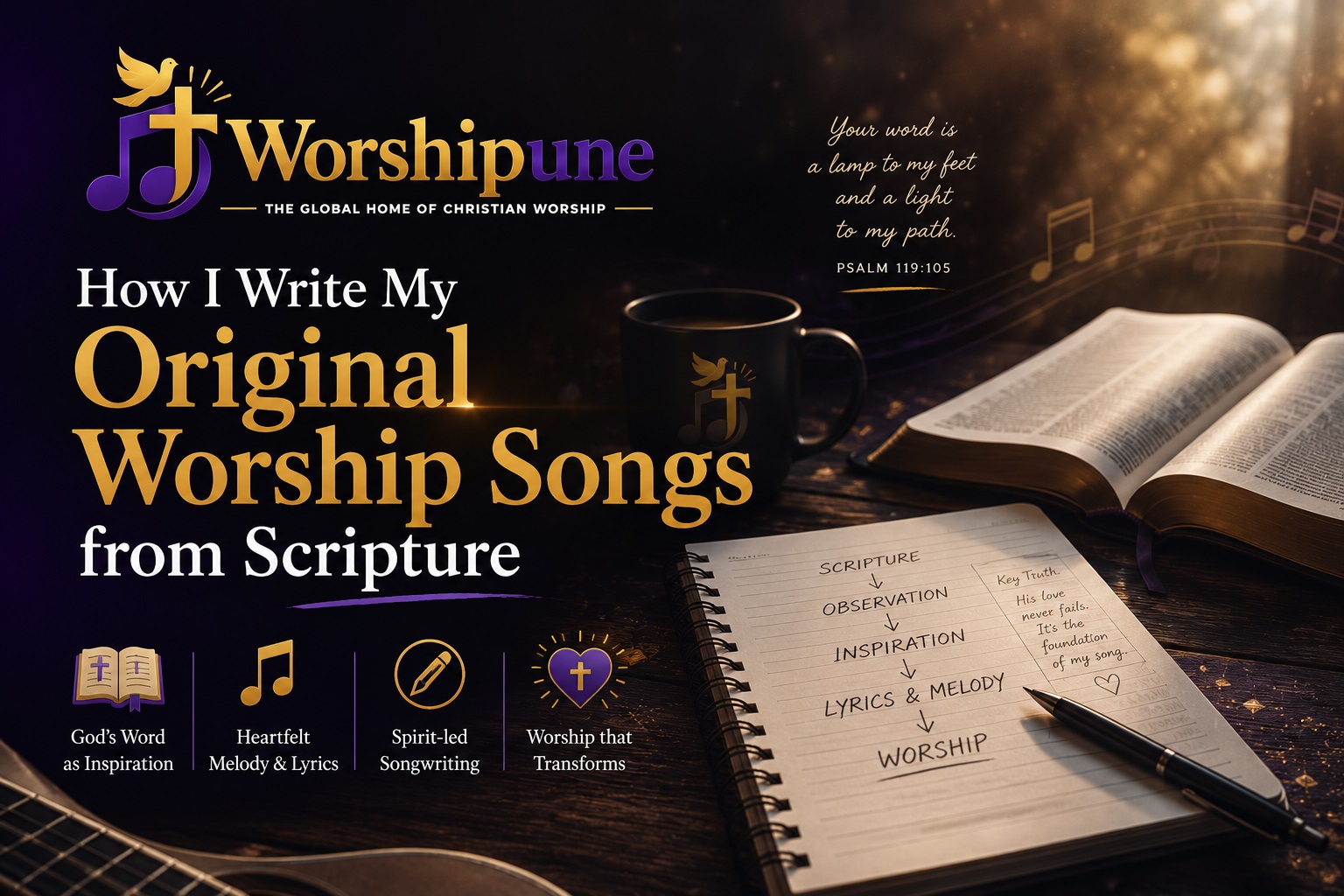
How I Write My Original Worship Songs from Scripture
There is a profound difference between a worship song that mentions the Bible and a worship song that was born from the Bible. I have written both kinds over the past seven years, and I can tell you from deep personal experience that the songs that come from genuine immersion in scripture carry a weight that no amount of musical skill, production polish, or marketing strategy can manufacture. When a congregation sings a song that was truly birthed in the Word, they can feel it in their spirits. There is an authority to it. A resonance. An unshakeable confidence. As if the song is not just being sung by human voices but is being confirmed by the Spirit of God Himself.
In this article, I want to pull back the curtain on exactly how I write my original worship songs from scripture. This is not a theoretical framework dreamed up in a classroom. This is the actual process I use, week after week, to turn the living Word of God into melodies and lyrics that people can sing in their cars, their living rooms, their hospital rooms, and their churches. If you have ever opened your Bible and felt the stirring of a song inside you but did not know how to bring it out into the light, this guide is for you.
Why Scripture Must Be the Starting Point
I learned this principle the hard way, through months of writing songs that felt good in the moment but dissolved like mist when the sun came out. In my first year of songwriting, I wrote songs based entirely on what I was feeling. If I felt grateful after a good day, I wrote a grateful song. If I felt broken during a hard week, I wrote a lament. The problem was that my feelings were unreliable. Some weeks I felt close to God, basking in His presence. Other weeks I felt distant, dry, confused, and spiritually numb. My songs reflected my emotional weather, and while they were honest, they were not always true. They were snapshots of my mood, not declarations of eternal truth.
Everything changed when I made scripture my starting point. The Bible is not a collection of suggestions or inspirational quotes. It is the revealed Word of God, breathed out by the Holy Spirit, and it contains everything we need for life and godliness. When I began writing songs from specific passages — not just referencing scripture in passing but building the entire song from the foundation of a biblical text — my lyrics became more precise, more powerful, and more durable. A song written from Psalm 23 does not stop being true when I am walking through a dark valley of suffering. A song written from Romans 8 does not lose its power when I feel condemned by my own failures. Scripture gives my songs a foundation that outlasts my emotions, my circumstances, and my shifting moods.
This is the first and most important principle of The Worshipune Way: the song must be biblically grounded before it is emotionally expressed. Not instead of emotion. Before emotion. The emotion flows from the truth, not the other way around. When the truth is established, the emotion has a safe place to land. When the emotion is established without the truth, it is a house built on sand.
My Scripture Selection Process: Listening for the Highlight
I do not choose scripture randomly. I do not flip open my Bible, point my finger to a verse, and say, “This will be my song today.” There is a discernment process I follow, and it has made all the difference in the quality, authenticity, and spiritual authority of my writing. I have learned to listen for what I call the “highlight” — the passage that the Holy Spirit seems to be illuminating in my life.
First, I look for scriptures that are already alive in me. I pay close attention to what the Holy Spirit is highlighting in my daily reading. If a particular passage keeps coming up in my devotional time, if I find myself returning to it throughout the day, if it surfaces in sermons I hear or conversations I have — that is usually a sign that God wants to do something with it. I have a note in my phone called “Song Scripture Ideas” where I record these passages. Some have been sitting there for months, waiting for the right moment. Some have been there for over a year. I do not rush them. I trust God’s timing.
Second, I look for scriptures with emotional and theological depth. Not every verse makes a great worship song. Some passages are instructional, giving commands about how to live. Some are narrative, telling stories of ancient battles and genealogies. I look for passages that contain a truth about God that also evokes a deep human response. Psalm 103:1-5, for example, contains both a command to praise and a beautiful list of reasons why God deserves praise — He forgives, He heals, He redeems, He crowns, He satisfies. That is rich song material. Romans 8:38-39 contains a staggering promise about the inseparability of God’s love. That is song material. I look for the intersection of divine truth and human longing, where the vertical reality of God meets the horizontal need of the human heart.
Third, I consider the season of the church and the world. I write songs not just for my own expression but for the body of Christ. If I know my church is walking through a season of uncertainty, economic hardship, or cultural pressure, I might lean into scriptures about God’s sovereignty and His unfailing provision. If the community is celebrating a season of growth and new believers, I might lean into scriptures about joy and the greatness of salvation. If the world is reeling from tragedy, I might lean into scriptures about lament and God’s presence in suffering. The best worship songs are timely. They meet people where they are and carry them to where God wants them to be.
The Immersion Method: Living with the Passage
Once I have selected a scripture, I do not rush to write. This is the most important and most neglected part of scripture-based songwriting. Most songwriters, myself included in my early days, read a verse once, feel a spark of inspiration, and start writing immediately. The result is often shallow. The song might reference the scripture, but it does not embody the scripture. It quotes the text without digesting it. It uses the Bible as a decoration rather than a foundation.
My immersion method has four distinct phases, and I spend at least a week — sometimes two or three — in each passage before I write a single lyric. This investment of time pays dividends in the depth and authenticity of the final song.
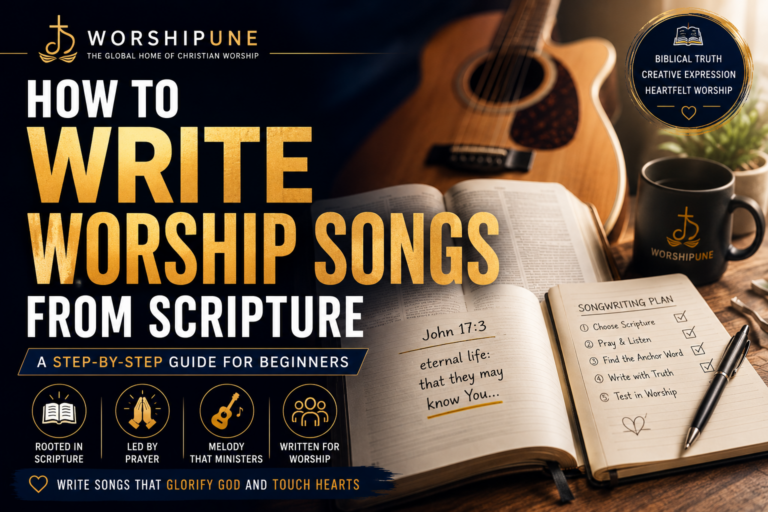
Phase 1: Read and Record. I read the passage every day for at least seven days. I read it slowly. I read it aloud. I read it in at least three translations: the ESV for its accuracy and literary beauty, the NLT for its clarity and accessibility, and The Message for its fresh, contemporary phrasing that sometimes unlocks an angle I had not seen before. Reading across translations prevents me from getting stuck in familiar wording and opens up new lyrical possibilities. I also write the passage out by hand in my journal. There is something about the physical act of writing — the slowness of it, the intentionality of forming each letter — that helps me absorb the words in a way that reading alone cannot achieve. When I write by hand, I notice details I would have skimmed over on a screen. I notice repeated words. I notice parallel structures. I notice emotional shifts that I might have missed.
Phase 2: Question and Explore. I ask the passage questions. Deep questions. Who is speaking? Who is the original audience? What is the historical and cultural context? What is the emotional tone? What promises are being made? What commands are being given? What metaphors are being used? What is the literary structure? I use a study Bible and reputable commentaries to dig deeper. I want to understand not just what the passage says on the surface but what it means in its fullness. I want to know the original intent before I apply it to my own life. This prevents proof-texting — taking a verse out of context to make it say what I want it to say.
Phase 3: Personalize and Pray. I turn the passage into prayer. I rewrite it in the first person, applying it to my own life with specific details. If the passage says “The Lord is my shepherd,” I write out what that means for me specifically: “Lord, You are my shepherd. You lead me when I am lost and confused. You provide for me when I am lacking. You protect me when I am afraid. You restore my soul when I am weary.” This personalization bridges the gap between ancient text and contemporary song. It makes the scripture mine before I try to make it a song for others.
Phase 4: Listen and Wait. This is the hardest phase for me because I am naturally impatient. I like to produce. I like to finish things. But I have learned that the best songs cannot be rushed. I simply sit with the passage in silence. I play soft instrumental music. I wait. I listen. I ask the Holy Spirit to reveal the melody and the lyric that He wants to birth from this word. Sometimes nothing comes for days. Sometimes a flood comes in a single moment while I am driving or washing dishes or walking in the park. Either way, I wait. The song that emerges from waiting is always better than the song that emerges from rushing. Waiting is not passive. Waiting is active trust.
Turning Scripture into Lyric: My Translation Process
After immersion, I begin the work of translation. I am not trying to paraphrase the Bible or create a musical version of a commentary. I am trying to capture the heart of the passage in language that sings — language that is both theologically faithful and poetically alive. This requires both theological precision and artistic skill. It is the most demanding part of the songwriting process, and it is where the song either comes alive or falls flat.
I start by identifying the core truth of the passage. What is the one thing God is saying here? For Psalm 23, it is that God is a personal, present, and provision-making shepherd who cares for His sheep in every season of life. For Isaiah 43:1-3, it is that God claims, protects, and redeems His people, and He will be with them through every trial. For John 15:1-8, it is that abiding in Christ is the source of true fruitfulness, and apart from Him we can do nothing. I write this core truth as a single sentence. Everything in the song must point back to it. If a line does not serve this core truth, it does not belong in the song.
Next, I look for the emotional arc of the passage. Does it move from fear to confidence? From sorrow to joy? From distance to nearness? From confusion to clarity? The song should follow this arc. If the passage begins with lament and ends with praise, the song should too. If the passage begins with a command and ends with a promise, the song should reflect that journey. This emotional arc creates an authentic journey for the listener. It allows them to enter the song where they are and be carried to where God wants them to be.
Then I look for key phrases in the passage that can become anchors in the song. In Psalm 23, “valley of the shadow of death” is too long for a lyric, but “shadow of death” or “even here” or “still waters” could work beautifully. In Isaiah 43, “I have called you by name” is a powerful, singable line. In John 15, “abide in me” is already concise and musical. I do not force these phrases. I let them emerge naturally as I write. Sometimes the Holy Spirit highlights a phrase that I would have overlooked, and it becomes the centerpiece of the entire song.
I also pay close attention to the metaphors in the passage. The Bible is rich with imagery — shepherd, vine, rock, fortress, light, bread, water, fire, wind, eagle’s wings. These metaphors are gifts to songwriters. They allow us to communicate abstract truths through concrete images that engage the senses and the imagination. When I write from Psalm 23, I do not just say “God takes care of me.” I say “You lead me beside quiet waters. You restore my soul. You prepare a table before me in the presence of my enemies.” The metaphor does the work. The image carries the truth in a way that abstract language cannot.
Case Study: Writing “Even Here” from Psalm 139
Let me walk you through a real, detailed example from my own catalog. The song “Even Here” was written entirely from Psalm 139:7-12. The passage reads: “Where can I go from your Spirit? Where can I flee from your presence? If I go up to the heavens, you are there; if I make my bed in the depths, you are there. If I rise on the wings of the dawn, if I settle on the far side of the sea, even there your hand will guide me, your right hand will hold me fast. If I say, ‘Surely the darkness will hide me and the light become night around me,’ even the darkness will not be dark to you; the night will shine like the day, for darkness is as light to you.”
Immersion Phase: I spent two full weeks with this passage. I wrote it out daily in my journal. I prayed it every morning. I personalized it: “Lord, even when I run from You, You are there. Even when I hide in my shame, You find me. Even when I go to the darkest place I can imagine — the place of my deepest failure, my most hidden sin, my most paralyzing fear — Your hand is already there. You are not surprised by my darkness. You are not repelled by my brokenness. You are even here.”
Core Truth: God is inescapably present. There is nowhere I can go that is beyond His reach, His sight, or His love. Not heaven. Not hell. Not the far side of the sea. Not the darkness inside my own soul.
Emotional Arc: The passage moves from a question that sounds like resistance (“Where can I flee?”) to a declaration of surrender and trust (“Even there your hand will guide me”). The song follows this arc: from hiding to being found, from running to resting, from fear to peace.
Key Phrases: “Where can I go,” “even there,” “your hand will guide me,” “your right hand will hold me fast,” “darkness is as light to you.”
Lyric Development: The chorus became: “Even here, even now, even in the dark, You are found. Even here, even now, Your hand is holding me.” The verse drew from the imagery of the passage: “If I rise on wings of morning, if I fall to the depths below, if I run to the edge of the ocean, still Your love will find me.” The bridge was a direct quote adapted for singing: “Where can I go from Your Spirit? Where can I hide from Your face? Nowhere. Nowhere. Even the darkness is light to You.”
The Result: When I first sang this song in my small group, a woman who had been struggling with depression for months wept quietly throughout the entire song. She told me afterward, “I needed to know that God is even here, in this dark place I have been in. Your song told me He is. I felt Him while we were singing.” That is the power of writing from scripture. The song carries the authority of the Word because it came from the Word. It is not my cleverness that moved her. It is the truth of God, sung back to Him in a new melody.
Common Pitfalls in Scripture-Based Songwriting
Even with the best intentions, it is easy to go wrong when writing from scripture. Here are the pitfalls I have fallen into and how I avoid them now.
Pitfall 1: Proof-texting. Taking a verse out of context to make it say what I want it to say. I now read the full chapter, sometimes the full book, to make sure I understand the context before I write. I want to honor the original meaning, not hijack it for my own purposes.
Pitfall 2: Over-quoting. Filling the song with so many direct Bible quotes that it feels like a recitation rather than a song. I aim for about 20-30% direct reference and 70-80% original lyric that embodies the truth. The scripture should inspire the song, not replace it.
Pitfall 3: Ignoring the original audience. The Psalms were written by Israelites in specific historical circumstances. Paul’s letters were written to specific churches facing specific problems. I try to honor the original context while finding the universal application. This prevents anachronism and deepens the song’s richness.
Pitfall 4: Making it too intellectual. A scripture-based song can be theologically dense but still emotionally cold. I always ask: Does this song help someone feel the truth, not just understand it? Does it create an encounter, or just convey information?
Pitfall 5: Forcing a scripture into a pre-existing melody. Sometimes I have a melody I love and I try to make a scripture fit it. It rarely works. The scripture should shape the melody, not the other way around. The text is the master; the music is the servant.
Practical Tools I Use Every Week
Here are the tools that make this process sustainable for me over the long term. I use these every single week without exception, and they have become as essential to my songwriting as my guitar or my piano.
-
YouVersion Bible App: I use the audio feature to hear the passage read aloud. Hearing it changes how I absorb it. Sometimes I listen to the same passage on repeat while I walk or drive. There is something about hearing the Word spoken that unlocks a different part of my brain than reading silently. I often find myself singing along with the audio, and that is usually when the first melodic ideas emerge.
-
Blue Letter Bible: For Hebrew and Greek word studies. Understanding the original language often unlocks new lyrical possibilities that no English translation can capture. The Hebrew word for “wait” in Isaiah 40:31 is “qavah,” which means to bind together like cords in a rope. That image — of being braided together with God’s strength — changed how I wrote a song about waiting on God. The Greek word for “love” in 1 Corinthians 13 is “agape,” which means selfless, sacrificial love that chooses the beloved regardless of response. These linguistic discoveries have transformed my lyrics countless times.
-
Voice Memos: For capturing melody ideas that come during scripture reading. I have lost too many good ideas by thinking I would remember them later. I record everything now. I have a folder called “Scripture Melodies” that is separate from my general song ideas, and it contains over a hundred recordings of melodies that came directly from my time in the Word. Some have become full songs. Others are still waiting for the right moment.
-
Notion: For organizing my scripture ideas, song drafts, and completed lyrics in one searchable database. I tag each song by scripture reference, theme, emotional tone, and current status (idea, draft, testing, finished). This system allows me to see patterns in my writing and to quickly find songs that fit a particular theme when my pastor asks for something specific.
-
Physical Journal: I still write by hand. There is no substitute for the slowness and intentionality of pen and paper. My journal is my most sacred songwriting tool. It is filled with handwritten scriptures, prayers, and half-formed lyrics. I date every entry so I can look back and see how God has been speaking to me over time. Some of my best songs have come from journal entries I wrote months before I realized they were songs.
Your Invitation to Write from the Word
If you have been writing worship songs from your feelings alone, I am not saying you should stop. Feelings are real, and God speaks through them. But I am inviting you to go deeper. I am inviting you to let the Word of God be the well from which you draw. The songs that come from that well will be different. They will be sturdier. They will outlast your mood. They will carry the weight of eternity in three minutes.
Pick a passage today. Just one. Read it. Write it out. Pray it. Live with it for a week. Do not rush. Do not force. Just listen. And when the melody comes — and it will come, in God’s timing — you will know that it is not just your song. It is His song, sung through you, for His people, to His glory.
That is how I write my original worship songs from scripture. That is The Worshipune Way.

Rebecca Valley is an independent worship artist and founder of Worshipune, creating original worship music and song stories from Camden, NJ. Every song is written from real moment with Jesus. Connect at hello@worshipune.com