

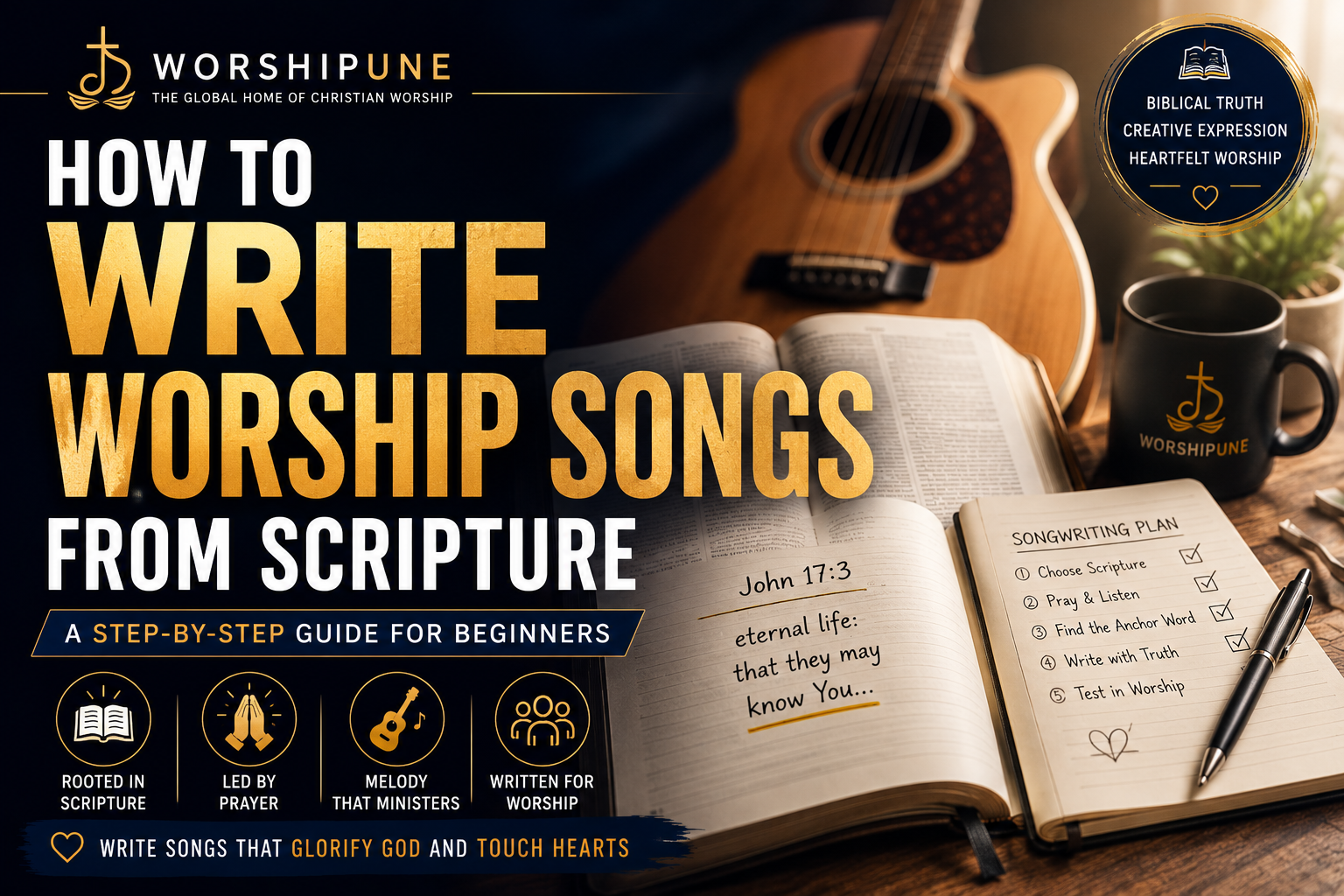
How to Write a Worship Song from Scripture: A Step-by-Step Guide for Beginners
There was a Tuesday morning in January when I sat on my living room floor with my guitar, a cup of coffee going cold, and my Bible open to John 17. I had been asked to lead worship at a small prayer gathering that weekend, and I wanted to bring something original — something that wasn’t just a cover of a Bethel or Hillsong song, but a song that came from the specific Scripture we were studying together.
I stared at verse 3 for what felt like an hour: “Now this is eternal life: that they know you, the only true God, and Jesus Christ, whom you have sent.”
The word know kept catching me. Not “believe in.” Not “serve.” Not “worship from a distance.” But know — intimately, personally, deeply. And slowly, almost without me trying, a melody started forming around that single word. Three months later, that living room moment became “So They Will Know” — one of the most personal songs I’ve ever written.
If you’ve ever wondered how to write a worship song from Scripture — not just a song with a vague Christian theme, but a song that truly emerges from the text, carries its weight, and helps people encounter God through His Word — this guide is for you. I’m going to walk you through the exact process I use every time I sit down to write. No music theory degree required. No expensive studio needed. Just you, your Bible, and a willingness to listen.
In this guide, you’ll learn:
-
How to choose the right Scripture passage for songwriting
-
My 5-step process for turning Scripture into lyrics and melody
-
How to avoid the common mistake of “proof-texting” your lyrics
-
Practical tips for matching musical mood to biblical emotion
-
A free downloadable songwriting worksheet you can use immediately
Table of Contents
Why Scripture Should Be the Foundation of Your Worship Songs.
When I first started writing worship songs, I made the mistake that most beginners make: I started with a feeling. I wanted to write something “uplifting” or “intimate” or “powerful,” and I’d hunt around for a Bible verse that seemed to fit the mood I was already chasing. The result? Songs that were emotionally honest but theologically thin. They might have sounded good in my bedroom, but they didn’t hold up when I tried to lead them in church.
Everything changed when I flipped the process. Instead of starting with emotion and finding Scripture to justify it, I started with Scripture and let the emotion emerge from the text itself.
The Difference Is Subtle But Massive
A song written from Scripture carries authority that a song written about Scripture rarely achieves. When your lyrics are rooted in the actual language, structure, and emotion of a biblical passage, you’re not just sharing your thoughts about God — you’re inviting people to encounter the same Word that has already shaped generations of believers.
Rebecca’s Note: I learned this the hard way. One of my early songs had a chorus that declared, “You are the fire in my bones!” It sounded passionate, but when a pastor gently asked me which Scripture inspired it, I realized I had made it up. The song wasn’t bad, but it wasn’t anchored. Now, every song I write starts with a specific passage, chapter, and verse.
Why Congregations Can Tell the Difference
Worship leaders often ask me why some original songs “stick” with a congregation while others fall flat. In my experience, the songs that stick are the ones where people can sense that something deeper than the songwriter’s personal devotion is happening. When a song is truly Scripture-born, there’s a weight to it — a sense that you’re not just hearing Rebecca Valley’s thoughts about God, but that you’re hearing something that echoes the prophets, the psalmists, and the apostles.
That doesn’t mean your songs shouldn’t be personal. They absolutely should. But the personal should emerge from the Scriptural, not the other way around. Think of it like a tree: Scripture is the root system, hidden but essential. Your personal experience is the fruit, visible and nourishing. But without the roots, the fruit doesn’t last.
The Biblical Precedent for Scripture-Saturated Songs
This isn’t a new idea I invented. The Psalms — the original worship songbook — are saturated with Scripture. The psalmists constantly reference God’s covenant, His law, His deeds, and His promises. When David writes, “The Lord is my shepherd” (Psalm 23), he’s not inventing a metaphor — he’s drawing from the entire biblical narrative of God shepherding His people from Exodus to the prophets.
The New Testament continues this pattern. Mary’s Magnificat (Luke 1:46–55) is essentially a tapestry of Old Testament quotations and allusions. When early believers sang hymns about Christ (Philippians 2:6–11, Colossians 1:15–20), they weren’t creating new theology — they were singing the truths the apostles had already taught.
So when you write a worship song from Scripture, you’re joining a tradition that stretches back thousands of years. That’s not intimidating — that’s empowering.
How to Choose the Right Passage for a Worship Song
Not every Scripture passage works well as a worship song. Some are too narrative-heavy (the genealogies in Chronicles, for example). Some are too complex for a 4-minute song (the arguments in Romans). Some are beautiful but not easily singable (the lament poetry of Jeremiah).
Over years of trial and error, I’ve developed a simple filter for choosing passages. I call it the SING Test:
The SING Test for Scripture Selection
Table
| Letter | Criterion | What to Look For | Example Passage |
|---|---|---|---|
| S | Simple | Can the core idea be stated in one sentence? | John 3:16 — “God loved the world so much He gave His Son” |
| I | Intimate | Does it reveal something personal about God’s character or relationship with us? | Psalm 23:1 — “The Lord is my shepherd” |
| N | Now | Does it speak to a present need or ongoing reality? | Philippians 4:6–7 — “Do not be anxious… the peace of God…” |
| G | Gathering | Can a group of people sing this together, not just an individual? | Revelation 5:9 — “You are worthy…” |
A passage doesn’t need to score perfectly on all four, but it should hit at least three. When I chose John 17:3 for “So They Will Know,” it scored S-I-N-G perfectly: simple (eternal life = knowing God), intimate (“that they know you“), now (eternal life is present tense), and gathering (“they” — plural, communal).
Where to Start Looking
If you’re overwhelmed by the whole Bible, start in these “songwriting goldmine” sections:
-
The Psalms — Obviously. But don’t just default to Psalm 23 or 139. Try Psalm 27 (“The Lord is my light and my salvation”), Psalm 42 (“As the deer pants for streams of water”), or Psalm 63 (“You, God, are my God, earnestly I seek you”).
-
The Gospels — Jesus’ words are incredibly song-friendly. The Beatitudes (Matthew 5), the Upper Room Discourse (John 13–17), and the Lord’s Prayer (Matthew 6) are rich with singable truths.
-
Paul’s Prayers — Ephesians 1:15–23, Philippians 1:9–11, and Colossians 1:9–14 are essentially worship songs already written in letter form.
-
The Revelation Songs — Revelation 4–5 is a worship leader’s dream: “Holy, holy, holy,” “Worthy is the Lamb,” “You are worthy, our Lord and God.”
Pro Tip: Keep a running note on your phone called “Song Ideas.” Every time you read Scripture and a verse “lights up” for you — write it down immediately. Don’t wait. I’ve lost dozens of good ideas because I told myself, “I’ll remember this.” I didn’t. Now, when I feel that spark, I stop and capture it. My current note has 47 ideas, and I add to it almost weekly.
Step 1: Lectio Divina for Songwriters — Listening Before Writing
The biggest mistake I see new worship songwriters make is this: they read a verse once, immediately start strumming their guitar, and try to force a melody onto the text. The result is usually a song that sounds like the Bible verse was duct-taped onto a pre-existing chord progression.
Instead, I use a modified version of Lectio Divina — the ancient practice of sacred reading — adapted specifically for songwriting. This isn’t about being mystical. It’s about slowing down enough that the Scripture can speak before you start speaking back.
My Modified Lectio Divina Process
1. Lectio (Read) — 5 Minutes Read the passage aloud. Not silently. Aloud. There’s something about hearing your own voice speak the words that engages a different part of your brain. Read it slowly. Read it twice. Don’t take notes. Don’t underline. Just let the words wash over you.
When I was working on “So They Will Know,” I read John 17:1–5 aloud three times. By the third reading, I noticed something I had missed in decades of reading that chapter: Jesus prays for Himself first (verses 1–5), then for His disciples (verses 6–19), then for all believers (verses 20–26). The structure is a widening circle of love — from personal to communal to universal. That structure became the structure of my song: verse 1 (my personal knowing), verse 2 (our communal knowing), bridge (the world’s knowing).
2. Meditatio (Meditate) — 10 Minutes Now, read the passage again, but this time, pause at every word that seems to “glow.” Not every word will. Some will feel flat. Some will feel heavy. But a few will feel like they have a light around them. Those are your anchor words.
For John 17:3, the glowing words for me were:
-
“Know” — not just intellectual knowledge, but intimate relationship
-
“True” — the only true God, implying there are false gods competing for our worship
-
“Sent” — Jesus was sent, which means He came on purpose, with a mission
I didn’t choose these words analytically. They chose me. That’s the difference between Lectio Divina and Bible study. Bible study asks, “What does this mean?” Lectio asks, “What is this saying to me?”
3. Oratio (Pray) — 5 Minutes Respond to the passage in prayer. Not formal prayer. Just honest conversation with God about what you’re hearing. This is where songwriting and prayer become almost indistinguishable. When you pray in response to Scripture, you’re essentially writing the first draft of your lyrics — you just don’t know it yet.
When I prayed through John 17:3, I found myself saying things like:
-
“God, I want to know You, not just know about You…”
-
“There are so many things I give my heart to that aren’t You…”
-
“Help me know You the way Jesus knows You…”
Those prayers became the raw material for my verses.
4. Contemplatio (Contemplate) — 10 Minutes Sit in silence. This is the hardest part for me. I’m a doer. I want to grab my guitar and start working. But I’ve learned that the songs that come out of contemplation are deeper than the songs that come out of impatience.
I set a timer for 10 minutes and just sit with the passage. Sometimes I hum quietly. Sometimes I journal a few lines. Sometimes I just sit. The goal isn’t to produce anything. The goal is to let the Scripture produce you.
Rebecca’s Note: I’ll be honest — I resisted this step for years. I thought it was “wasting time.” But after forcing myself to do it for 30 days, I noticed something: the songs I wrote after contemplation had a depth that my “quick” songs lacked. Congregations responded differently. Worship leaders told me the songs “carried something.” That something was the silence. Don’t skip it.
5. Compositio (Compose) — The Rest of Your Session Only after Lectio, Meditatio, Oratio, and Contemplatio do I pick up my instrument. By then, the passage has done its work on me. I’m not forcing the Scripture into a song. The song is emerging from the Scripture — and from my transformed response to it.
Step 2: Finding the “Anchor Word” That Holds the Song
Every worship song needs an anchor word — a single word or short phrase that the entire song revolves around. It’s not necessarily the title (though it often becomes the title). It’s the gravitational center of the song.
Think of some of the most powerful worship songs:
-
“How He Loves” — the anchor word is loves
-
“What a Beautiful Name” — the anchor word is name
-
“Goodness of God” — the anchor word is goodness
-
“So They Will Know” — the anchor word is know
The anchor word is usually the word that glowed brightest during your Meditatio step. But sometimes it’s a word that emerges during your prayer response. Either way, identifying it early gives your song a center of gravity.
How to Test Your Anchor Word
Once you think you’ve found it, ask these three questions:
-
Can I write a chorus around this word? The chorus is where the anchor word should live. It should appear 3–4 times in the chorus, ideally at the end of melodic phrases (the “landing spots” where the melody resolves).
-
Can the verses explore different facets of this word? If your anchor word is “know,” the verses might explore: knowing God in suffering, knowing God in joy, knowing God in community, knowing God in silence. Each verse deepens the same word without repeating the same idea.
-
Does this word work in both personal and corporate contexts? Can I sing “I know You” (personal) and “we know You” (corporate) using the same anchor word? If yes, you’ve found something powerful. If no, you might have a great song for private devotion but not for congregational worship.
My Anchor Word for “So They Will Know”
The word know passed all three tests:
-
Chorus test: “So they will know You, so they will know Your name…” — the word lands on the strongest beat of the melody.
-
Verse test: Verse 1 explores knowing God personally (“In the quiet, in the chaos, I want to know You more”). Verse 2 explores knowing God through Jesus (“You sent Your Son so we could know Your heart”). The bridge explores the world knowing God (“Let every nation, every tongue, declare they know You”).
-
Personal/corporate test: The song moves seamlessly from “I” to “we” to “they” without losing the anchor word.
If you can’t find an anchor word that passes all three tests, you might need to spend more time in Lectio Divina. The word is there. You just haven’t heard it yet.
Step 3: From Scripture to Lyric — The Paraphrase Method
This is where the rubber meets the road. You have your passage. You have your anchor word. Now you need actual lyrics. But here’s the trap: if you just quote the Bible verbatim, your song will sound like a Scripture memory tool, not a worship song. If you stray too far from the text, you lose the authority that comes from being Scripture-rooted.
The solution is what I call the Paraphrase Method — a three-layer process that keeps you anchored to the text while giving you creative freedom.
Layer 1: Direct Quotation (The Anchor)
Start by identifying the exact phrases from your passage that you want to preserve word-for-word. These are usually the most poetic, the most theologically dense, or the most emotionally charged lines.
From John 17:3, I chose to preserve:
-
“Eternal life” — because it’s the promise that frames everything
-
“The only true God” — because the word “true” carries so much weight
-
“Jesus Christ, whom you have sent” — because the missional aspect is crucial
These direct quotations become the “pillars” of your song — the lines that people will recognize as biblical even if they don’t know the exact reference.
Layer 2: Paraphrase (The Bridge)
Now, take the theological concepts from the passage and put them in your own words. This is where your personal voice emerges. The goal is to say the same thing the Bible says, but in a way that feels natural coming from your mouth.
Table
| Direct Quotation | My Paraphrase | Why It Works |
|---|---|---|
| “That they know you” | “I want to know You, not just know about You” | Adds the personal longing |
| “The only true God” | “In a world of false gods, You alone are true” | Contextualizes for modern listeners |
| “Jesus Christ, whom you have sent” | “You sent Your Son to show us who You are” | Simplifies without losing meaning |
The key is theological fidelity with linguistic freedom. You’re not changing the meaning. You’re translating it into your own poetic language.
Layer 3: Personal Response (The Heart)
Finally, add your own emotional and experiential response to the text. This is what makes the song yours and not just a Bible paraphrase. It’s also what makes it relatable to listeners who haven’t had your exact experiences but have had similar ones.
For “So They Will Know,” my personal response lines included:
-
“I’ve chased so many shadows, thinking they were light” — my confession of idolatry
-
“But every time I turn to You, I find what I’ve been searching for” — my testimony of redemption
-
“So let my life be a song that sings Your name” — my commitment to worship
These lines don’t appear in John 17:3. But they emerge from John 17:3. They’re the fruit of the root.
Pro Tip: When I’m stuck on a paraphrase, I use what I call the “Grandma Test.” If I can sing this line to my grandmother (who knows the Bible well but doesn’t use Christian jargon) and she understands it immediately, it’s a good paraphrase. If she looks confused, I need to simplify. Worship songs should be accessible to everyone from new believers to seminary professors.
The Paraphrase Ratio
In my experience, the best Scripture-based songs use this approximate ratio:
-
20% direct quotation — the biblical pillars
-
50% paraphrase — the theological bridge
-
30% personal response — the heart connection
If you have too much direct quotation, the song feels stiff. Too much personal response, and it loses biblical authority. Too much paraphrase without enough personal voice, and it feels generic. The 20-50-30 ratio isn’t a rigid rule, but it’s a helpful starting point.
Step 4: Matching Melody to Biblical Emotion {#step-4-matching-melody}
This is the step where most songwriting guides get vague. They tell you to “feel the emotion” and “let the melody flow.” That’s not wrong, but it’s not enough. As a worship songwriter, you need to be intentional about matching your melody to the biblical emotion of your passage — not just your personal emotional response.
What Is Biblical Emotion?
Every Scripture passage carries an emotional tone that emerges from its context, genre, and content. Psalm 23 is tender and reassuring. Psalm 22 is desperate and anguished. Revelation 19 is triumphant and awe-inspiring. John 17 is intimate and missional — Jesus praying for His disciples with deep love and urgent purpose.
When I wrote “So They Will Know,” I had to ask: What does John 17:3 sound like? Not “What do I feel when I read it?” but “What emotion does the text itself carry?”
The answer: longing intimacy with urgent purpose. Jesus is about to go to the cross. He’s praying for His disciples to truly know God. There’s tenderness, but there’s also weight. This isn’t a light, fluffy worship moment. This is a foundational prayer that shapes the entire Christian life.
Melodic Choices That Match Biblical Emotion
Table
| Biblical Emotion | Melodic Characteristics | Example Songs |
|---|---|---|
| Tender intimacy | Soft dynamics, narrow melodic range, stepwise motion, minor key or modal | “Goodness of God,” “So Will I” |
| Urgent proclamation | Driving rhythm, ascending melodic lines, strong downbeats, major key | “What a Beautiful Name,” “King of Kings” |
| Lament/grief | Descending lines, minor key, rubato (flexible tempo), sparse accompaniment | “Psalm 13” (Shane & Shane), “Though You Slay Me” |
| Triumph/celebration | Wide range, leaps, syncopation, major key, fast tempo | “Living Hope,” “Rattle!” |
| Awe/mystery | Suspended chords, ambiguous tonality, slow tempo, spacious arrangement | “Behold Our God,” “Oceans” |
For “So They Will Know,” I chose a melody that combined tender intimacy (narrow range, stepwise motion in the verses) with urgent proclamation (ascending chorus lines that build to a declaration). The verses feel like prayer. The chorus feels like prophecy. That dynamic arc matches the emotional journey of John 17.
The Chord Progression Question
You don’t need to be a music theory expert to write good worship songs. But you do need to understand that chord progressions carry emotional weight. Here are my go-to progressions for different biblical emotions:
For tender intimacy:
plain
| C | G/B | Am7 | F |This is the classic “worship progression.” It’s simple, predictable, and emotionally safe. It works for songs about God’s love, presence, and comfort.
For urgent proclamation:
plain
| C | F | Am | G |The movement from F to Am to G creates forward momentum. It feels like it’s going somewhere, which is perfect for songs about mission, calling, and declaration.
For lament:
plain
| Am | F | C | G |Starting on the minor chord (Am) immediately sets a somber tone. The progression feels unresolved, which is appropriate for songs about struggle, waiting, and grief.
For triumph:
plain
| C | G | Am | F | C/E | F | C | G |The longer progression creates a sense of journey and arrival. The C/E to F to C walk-down feels like a victory lap.
Rebecca’s Note: I use a simple rule: if I can play the chord progression on acoustic guitar while singing the melody, and it feels right without any production, it’s a good progression. Production can make a bad song sound okay, but it can’t make a bad melody good. Always test your songs naked — just voice and guitar — before you add anything else.
Tempo and Rhythm
The tempo of your song should match the biblical emotion too. John 17 is not a fast song. It’s not a slow ballad either. It’s a mid-tempo prayer — around 72–76 BPM (beats per minute). That tempo allows for both intimacy and urgency. It feels like a heartbeat that’s steady but purposeful.
When I demoed “So They Will Know” at 60 BPM, it felt too heavy and mournful. When I tried it at 90 BPM, it felt rushed and shallow. At 74 BPM, it felt right — like Jesus’ prayer in the Upper Room, measured and weighty but not dragging.
Step 5: Testing Your Song in Real Worship {#step-5-testing-your-song}
A song written in your bedroom is not a worship song yet. It’s a worship demo. The real test comes when you sing it with other people. I’ve written songs that I thought were powerful until I tried to lead them in a room with actual humans. And I’ve written songs that I thought were mediocre until a congregation sang them back to me with tears in their eyes.
The Three-Stage Testing Process
Stage 1: The Living Room Test (1–2 People) Sing the song for your spouse, a close friend, or a small group. Ask them:
-
“What word or phrase stuck with you?”
-
“Was there any line that confused you?”
-
“Did you want to sing along, or did you feel like you were watching a performance?”
When I first sang “So They Will Know” for my husband, he said, “The bridge is beautiful, but I don’t know who ‘they’ is. Is it the church? The world? Me?” That feedback made me rewrite the bridge to clarify: “Let every nation, every tongue, declare they know You.” The “they” became specific.
Stage 2: The Small Group Test (5–15 People) Lead the song at a home group, prayer meeting, or small worship gathering. This is where you learn if the song is actually singable. A song can be beautiful but unsingable — too many words, too wide a melodic range, too complex a rhythm.
Listen for:
-
Are people singing, or just listening?
-
Are they struggling with any particular phrase?
-
Do they seem to connect emotionally at the expected moments?
I once wrote a song with a chorus that jumped an octave. It sounded powerful when I sang it alone. But when I led it with a group, only the sopranos could hit the high note, and everyone else dropped out. I rewrote the chorus to stay within a comfortable range (about an octave and a third, from middle C to the E above high C for most voices).
Stage 3: The Congregation Test (50+ People) Only after passing Stages 1 and 2 do I bring a song to the main Sunday gathering. This is the final test. A song that works in a small group might get lost in a large room. A song that feels intimate in a living room might feel small on a stage.
Pay attention to:
-
Volume dynamics — Does the song need to build? Does it need moments of quiet?
-
Lyric projection — Are the lyrics easy to read and follow?
-
Band arrangement — Does the full band support the song or overpower it?
-
Congregational response — Are people engaged? Are they singing? Are they worshipping?
Pro Tip: I keep a “Song Journal” where I record feedback from every test. After each stage, I write: what worked, what didn’t, and what I changed. My journal for “So They Will Know” has entries from 12 different test sessions over 3 months. The final version is very different from the first draft — and much better because of it.
When to Let a Song Go
Not every song makes it to Stage 3. Some songs are meant for private devotion, not congregational worship. Some songs are teaching tools, not worship tools. Some songs are just practice — stepping stones to better songs.
I’ve written probably 80 songs. About 30 have been tested in small groups. About 15 have made it to congregational worship. And about 8 are songs I regularly lead and that congregations have adopted. That’s a good ratio. Don’t be afraid to let songs go. The goal isn’t to write as many songs as possible. The goal is to write songs that help people worship in spirit and truth.
The Mistake Every Beginner Makes (And How to Avoid It) {#the-mistake-every-beginner-makes}
I alluded to this earlier, but it deserves its own section because it’s so common and so damaging. The mistake is proof-texting — taking a Bible verse out of context and using it to support a pre-existing idea or emotion.
What Proof-Texting Looks Like in Worship Songs
-
Using Philippians 4:13 (“I can do all things through Christ”) to write a song about personal achievement and success — ignoring that Paul wrote it from prison about contentment in suffering.
-
Using Jeremiah 29:11 (“For I know the plans I have for you”) to write a song about guaranteed prosperity — ignoring that the original promise was to exiles in Babylon and involved 70 years of waiting.
-
Using Psalm 139:14 (“I am fearfully and wonderfully made”) to write a song about self-esteem — ignoring that the psalmist’s point is God’s omniscience and omnipresence, not human self-worth.
These aren’t terrible songs. They’re just theologically thin songs. And over time, thin songs shape thin faith. When congregations sing “I can do all things” as a prosperity anthem, they’re not being strengthened by Paul’s actual message — they’re being misled by a misreading.
How to Avoid Proof-Texting
1. Read the whole chapter, not just the verse. Before you write from John 3:16, read John 3:1–21. Before you write from Psalm 23, read Psalm 22 and 24 too. Context is everything.
2. Ask: “What did this mean to the original audience?” John 17 wasn’t written for 21st-century American worshippers. It was Jesus praying for His first-century disciples. What did “know” mean to them? What did “eternal life” mean? Understanding the original meaning protects you from imposing your own meaning onto the text.
3. Ask: “What does this mean in the whole Bible’s story?” How does John 17:3 connect to Genesis 3 (the fall, where knowing God was lost)? How does it connect to Exodus (where God reveals His name)? How does it connect to the New Testament (where knowing God is restored through Christ)? The more you see the big picture, the richer your song will be.
4. Let the text shape your song, not the other way around. If you find yourself twisting the Scripture to fit your song idea, stop. Either change the song to fit the Scripture, or choose a different Scripture. The text is the authority. Your song is the response.
Rebecca’s Note: I made this mistake early on. I wanted to write a song about God’s faithfulness in hard times, and I found Psalm 46:1 — “God is our refuge and strength, an ever-present help in trouble.” Perfect, right? But I didn’t read the rest of the psalm. If I had, I would have seen that the “trouble” in Psalm 46 is specifically about nations raging and kingdoms falling — political chaos, not personal hardship. My song wasn’t wrong, but it was shallower than it could have been. Now I always read the whole chapter. Always.
Free Download: The Worship Songwriting Scripture Worksheet
To help you put this process into practice immediately, I’ve created The Worship Songwriting Scripture Worksheet — a printable PDF that walks you through every step of this guide in a structured format.
What’s Included:
-
The SING Test — A checklist for evaluating Scripture passages
-
Lectio Divina Template — Guided prompts for each of the 5 steps
-
Anchor Word Discovery — Questions to help you find your song’s center
-
Paraphrase Method Worksheet — Three-column layout for direct quotation, paraphrase, and personal response
-
Melody Matching Guide — Quick reference for matching biblical emotion to musical choices
-
Testing Feedback Form — Structured questions for each of the 3 testing stages
-
Song Journal Template — A page to record your songwriting journey
How to Use It:
-
Print the worksheet (or use it digitally on a tablet)
-
Choose a Scripture passage using the SING Test
-
Work through each section during your songwriting session
-
Save completed worksheets in a binder or folder
-
Review past worksheets to see your growth over time
(Note: This link will direct you to a signup page where you can join the Worshipune community and receive the worksheet via email. You’ll also get weekly devotionals, new song notifications, and exclusive worship resources.)
FAQ: Common Questions About Writing Worship Songs from Scripture
Do I need to know music theory to write worship songs from Scripture?
No. I know very little music theory, and I’ve written songs that are sung in churches across multiple states. What you need is a willingness to listen — to the Scripture, to your own heart, and to the people you’re writing for. Music theory can help, but it’s not required. Some of the most powerful worship songs in history were written by people with no formal training.
Can I use AI to help me write worship lyrics?
You can use AI as a brainstorming tool, but I don’t recommend relying on it for the actual writing. AI can suggest rhymes, generate chord progressions, or help you organize ideas. But it can’t have a personal encounter with God through Scripture. It can’t testify to redemption. It can’t carry the spiritual weight that comes from lived faith. If you use AI, use it for structure, not for soul.
How long does it take to write a worship song from Scripture?
For me, the Lectio Divina process takes about 30–45 minutes. The actual writing (lyrics and melody) takes another 1–2 hours. But the testing process takes weeks or months. “So They Will Know” took 3 months from first draft to final version. Some songs take longer. Some come faster. There’s no right timeline. The goal is faithfulness, not speed.
What if my church doesn’t sing original songs?
Start small. Share your song with your worship leader. Offer to lead it at a prayer meeting or small group. Many churches are hungry for fresh, local, Scripture-rooted songs — they just don’t know where to find them. You might be the answer to their prayer. And if your church isn’t open to original songs, that’s okay. Your songs can still serve people online, in home groups, and in other churches.
How do I copyright my original worship songs?
In the United States, your song is automatically copyrighted the moment you write it down or record it. But for full protection, you should register it with the U.S. Copyright Office (copyright.gov). I also recommend joining a performing rights organization like ASCAP, BMI, or SESAC to collect royalties if your song is played publicly. For a full guide, see my post: How to Copyright Your Worship Songs (Step-by-Step).
Conclusion: Your Living Room Moment Is Coming
If you’ve read this far, I want you to know something: your living room moment is coming.
That Tuesday morning on my floor with John 17 wasn’t a special day. I didn’t feel inspired. I didn’t have a breakthrough. I just showed up — Bible open, guitar nearby, heart willing. And God met me there. Not because I’m special. Not because I’m talented. But because He loves to meet us in the ordinary moments when we make space for Him.
You don’t need a recording studio. You don’t need a theology degree. You don’t need a massive platform. You need a Bible, a willingness to listen, and the courage to sing what you hear.
The church needs your songs. Not because we need more content. But because we need more voices that are rooted in Scripture, shaped by prayer, and tested in real worship. We need songs that help us know God — truly know Him — in a world full of noise and distraction.
So pick up your Bible. Find a passage that glows. Sit with it. Pray through it. Let it shape you. Then pick up your guitar and sing.
Your song is already there. You just have to write it down.
If this guide helped you, I’d love to hear about it. Leave a comment below with the Scripture passage you’re currently writing from, or share your biggest songwriting struggle. And if you want to see this process in action, watch the video below where I walk through how I wrote “So They Will Know” from John 17:3 — from first draft to final recording.
Don’t forget to https://worshipune.com/free-resources/worship-songwriting-worksheet to put these steps into practice today.

Rebecca Valley is an independent worship artist and founder of Worshipune, creating original worship music and song stories from Camden, NJ. Every song is written from real moment with Jesus. Connect at hello@worshipune.com

