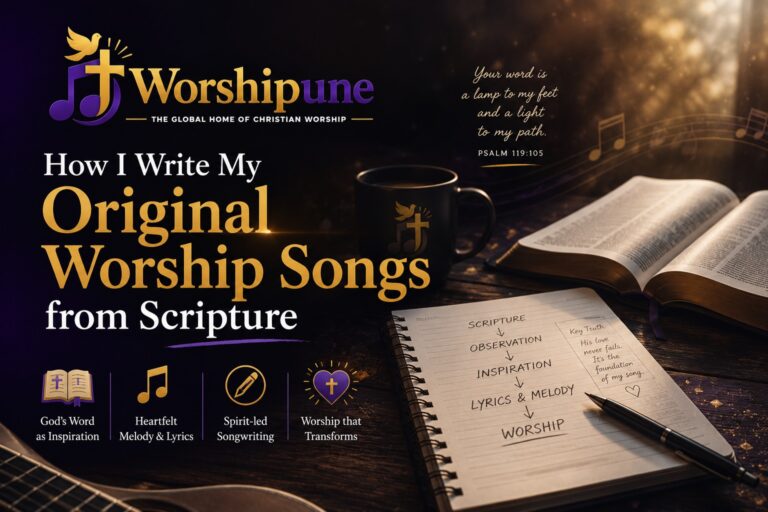
How to Write Worship Lyrics Directly from Scripture
Introduction
Some of the most enduring worship songs in history were born directly from the pages of scripture. “Amazing Grace” echoes Ephesians 2:8. “How Great Thou Art” reflects Psalm 104. “10,000 Reasons” draws from Psalm 103. When worship lyrics are rooted in scripture, they carry an authority that purely imaginative lyrics cannot replicate. They are not just human expressions of devotion—they are Spirit-breathed truths set to music.
But there is an art to translating scripture into lyrics. A worship song is not a Bible verse with a chord progression. It is a creative, Spirit-led reinterpretation of divine truth into the language of the heart. In this guide, I will walk you through the exact method I use at Worshipune to write lyrics directly from scripture. This is the same process that produced songs like “You Are My Refuge” (Psalm 91) and “Grace Upon Grace” (John 1:16). If you are building a songwriting practice, this technique should be central to your craft. For the full context of how this fits into the larger process, see my complete songwriting framework.
Why Scripture-Based Lyrics Are Non-Negotiable
The worship song is one of the most powerful teaching tools in the church. Congregations sing the same songs week after week, month after month, year after year. The lyrics they absorb shape their theology, often more than the sermons they hear. A theologically weak worship song can subtly erode a believer’s understanding of God. A theologically rich worship song can reinforce truth for a lifetime.
When I write from scripture, I am not just being theologically safe. I am being spiritually aligned. The Holy Spirit inspired the Bible. When my lyrics flow from the Bible, they are more likely to carry the same resonance. This does not mean every lyric must be a direct quotation. It means every lyric must be a faithful reflection of biblical truth.
At Worshipune, I have made a personal commitment: no song will be released unless I can trace its central theme to specific scripture. This discipline has saved me from writing empty platitudes and has given my songs a weight that I could never manufacture on my own.
Step 1: Choose Your Passage with Prayer
I do not choose scripture randomly. I choose it in response to what God is doing in my life and in my community. During a season of anxiety, I was drawn to Philippians 4:6-7. During a season of gratitude, I kept returning to Psalm 103. The scripture chooses me as much as I choose it.
When selecting a passage, I look for:
-
Emotional resonance — Does this passage stir something in my spirit?
-
Thematic clarity — Does it have a clear, singular message that can anchor a song?
-
Singability potential — Can the language be adapted into lyrical, musical form?
-
Congregational relevance — Will this truth meet a real need in the church today?
I avoid passages that are too narrative-heavy (like detailed genealogies or ceremonial laws) unless I am writing a specific type of worship ballad. I gravitate toward the Psalms, the Gospels, the epistles, and prophetic declarations because they are already written in poetic, emotional language.
Step 2: Study and Meditate Deeply
Once I have chosen a passage, I do not rush to write. I study. I read the passage in multiple translations—ESV for accuracy, NLT for accessibility, NASB for literalness, and sometimes The Message for fresh phrasing. I read the surrounding context to ensure I am not taking a verse out of its intended meaning.
I also consult commentaries. I want to understand what the original author meant, what the original audience heard, and how the passage fits into the larger biblical narrative. This study phase can take hours or days. It is not wasted time. It is the foundation upon which the song will stand.
During this phase, I keep a notebook of observations. I write down:
-
Key words and phrases that leap out
-
Emotional tones (fear, joy, awe, repentance, hope)
-
Theological truths embedded in the text
-
Personal connections to my own life
-
Potential lyrical images or metaphors
By the end of this phase, I usually have 2-3 pages of raw material. The song is not yet visible, but the ingredients are gathered.
Step 3: Identify the Central Truth and Hook
Every scripture passage has a central truth. My job is to distill it into a single, memorable statement—the hook. This hook will become the chorus or the song title.
For Psalm 91, the central truth is God’s protection. The hook I extracted was: “You are my refuge, my fortress, my God in whom I trust.” This is not a direct quotation, but it is a faithful condensation of the psalm’s declarations. It captures the essence without losing the poetry.
For John 1:16, the central truth is the abundance of grace. The hook became: “Grace upon grace, You pour out on me.” The phrase “grace upon grace” is directly from the ESV translation, but the second half makes it personal and singable.
The hook must be:
-
Biblically accurate — it reflects the passage’s meaning.
-
Emotionally compelling — it moves the heart.
-
Musically concise — it fits a melodic line without cramming.
Step 4: Translate Scripture into Contemporary Lyrics
This is the most creative step. I take the biblical language and translate it into modern, singable lyrics without losing theological precision. I use three techniques:
Direct Quotation
Sometimes the biblical phrasing is already perfect. “How great is our God” is essentially a direct quotation of Psalm 104:1. When the original language sings, I use it. But I am careful not to force archaic phrasing into a modern melody. “Thou art” might be biblical, but “You are” is more singable for today’s congregation.
Parallel Restatement
I restate the biblical truth in contemporary language while preserving the original structure. For example, Psalm 23:1 says, “The Lord is my shepherd; I shall not want.” A parallel restatement might be: “You lead me beside still waters, You provide for every need.” It says the same thing in fresh words.
Personal Application
I bring the scripture into the first person, making it a prayer. Psalm 91:2 says, “I will say to the Lord, ‘My refuge and my fortress, my God, in whom I trust.'” My lyric became: “I will say it to the world, You are my refuge, You are my God.” The truth is identical. The voice is personal.
Step 5: Match Lyrics to Melody and Meter
Once the lyrics are drafted, I test them for singability. I read them aloud, tapping a steady beat. I count syllables per line. I ensure the stressed syllables fall on the strong beats. If a line is too long, I cut words. If it is too short, I add connecting words like “oh,” “now,” or “and.”
I also test the emotional arc. Do the lyrics build naturally? Does the verse lead into the chorus? Does the bridge provide a new angle? The scripture itself often provides this structure. Psalm 91 moves from declaration to testimony to promise. My song followed that same arc.
For more on how I structure these elements into a full song, see my guide on how to structure a worship song for congregational singing.
Real Example: From Psalm 91 to “You Are My Refuge”
Let me show you the actual translation process for one of my Worshipune songs.
Scripture (Psalm 91:1-2, ESV):
“He who dwells in the shelter of the Most High will abide in the shadow of the Almighty. I will say to the Lord, ‘My refuge and my fortress, my God, in whom I trust.'”
My Lyric Translation:
Verse 1:
“I dwell in the shelter of the Most High
I rest in the shadow of the Almighty
You are my refuge, my fortress, my God
In You I will trust, in You I will trust”
What changed:
-
“He who dwells” became “I dwell” — personal application.
-
“Will abide” became “I rest” — present tense, more intimate.
-
The quotation marks were removed — the lyric became a direct declaration rather than a reported speech.
-
“In whom I trust” became “In You I will trust” — second person, more worshipful, and repeated for emphasis.
The Result: The song is biblically faithful but personally expressive. It can be sung by any believer as their own prayer. That is the goal of scripture-based lyric writing.
Common Pitfalls to Avoid
Pitfall 1: Proof-Texting
Taking a single verse out of context to support a pre-existing song idea. Always read the surrounding passage. Always understand the original context. A song based on a misinterpreted verse is worse than a song with no scripture at all.
Pitfall 2: Wooden Literalism
Forcing every biblical phrase into the lyrics without adaptation. The Bible was not written to be sung in 4/4 time. Some phrases need to be restructured, abbreviated, or expanded. The truth must remain. The exact wording can flex.
Pitfall 3: Thesaurus Syndrome
Replacing simple biblical words with complex synonyms to sound more poetic. “God’s love” is better than “the ineffable benevolence of the Divine.” Clarity is more important than impressiveness.
Conclusion: Let the Word Dwell in You Richly
Colossians 3:16 says, “Let the word of Christ dwell in you richly, teaching and admonishing one another in all wisdom, singing psalms and hymns and spiritual songs.” This is the blueprint for worship songwriting. The Word dwells in us first. Then it flows out in song. Then it teaches and admonishes the church.
When you write worship lyrics directly from scripture, you are participating in a tradition that stretches back to the Psalms. You are joining David, Asaph, the Sons of Korah, and every worshipper who has ever taken divine truth and set it to music. Your song becomes a vehicle for the Word to dwell in your congregation richly.
Start today. Open your Bible. Read until something burns in your chest. Then write. Not for fame. Not for platforms. But because the Word is too good to keep silent. And because the church needs songs that are rooted in eternal truth, not fleeting emotion.
For the full songwriting process that incorporates this lyric technique, read my complete songwriting framework. And if you want to know which chord progressions bring these lyrics to life, check out my guide on worship chord progressions that move the heart.
Meta Description:

Rebecca Valley is an independent worship artist and founder of Worshipune, creating original worship music and song stories from Camden, NJ. Every song is written from real moment with Jesus. Connect at hello@worshipune.com