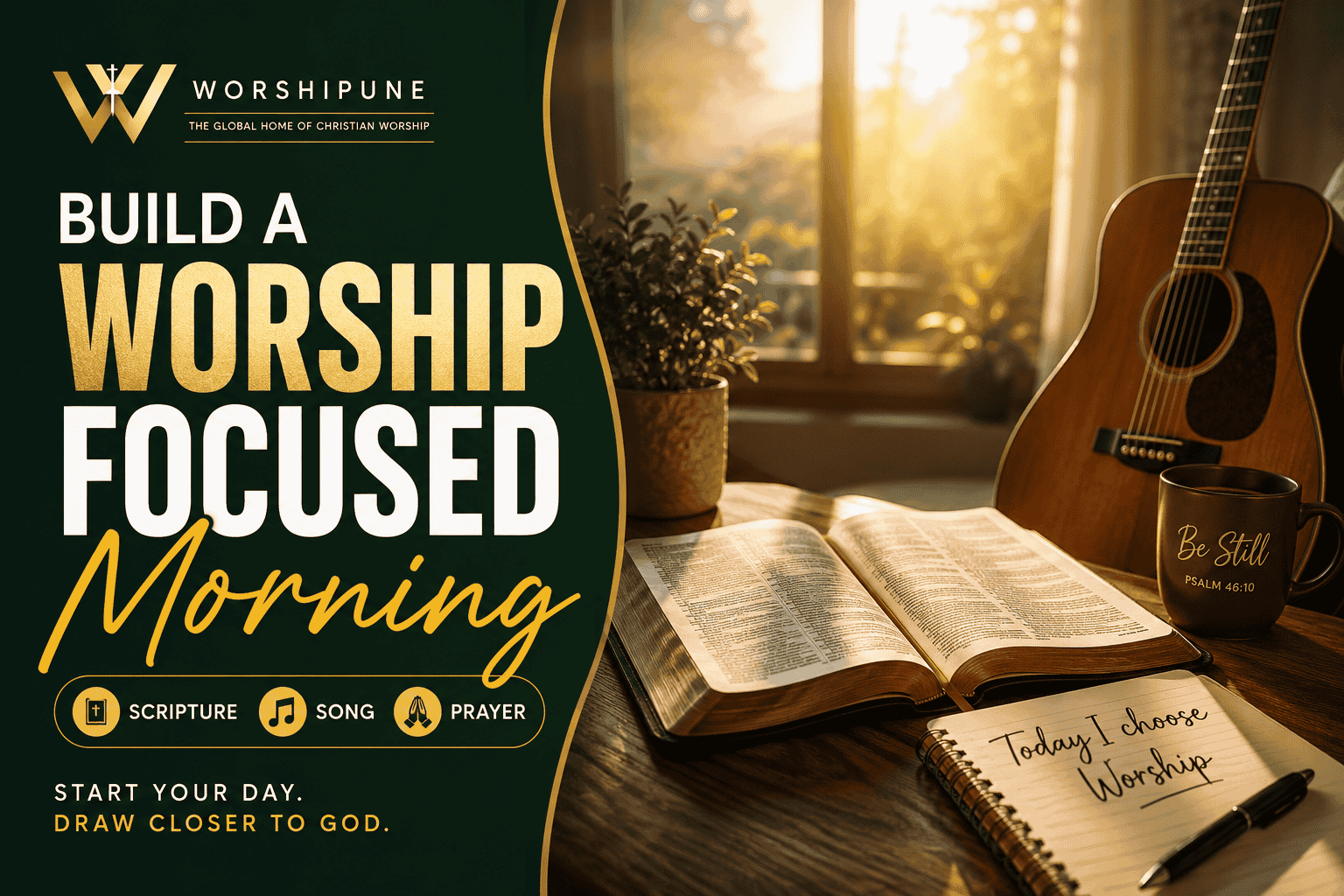
Creating a Worship-Focused Morning Routine: Scripture, Song, and Prayer
There was a season in my life — about three years ago — when my mornings felt like a race I was losing before I even got out of bed. My alarm would blare at 6:15 AM, I’d grab my phone to silence it, and suddenly I’d be scrolling through emails, Instagram notifications, and news headlines while still horizontal, still half-asleep, still trying to remember what day it was. By the time my feet hit the floor at 6:42, I was already anxious, already behind, already carrying the weight of ten different demands before I’d spoken to God once.
My worship leading suffered. My songwriting felt hollow. My prayer life became a series of rushed bullet points fired upward during my commute — “Lord, help me through this meeting” and “Please heal my friend’s mom” and “I need strength today, amen” — as if God were a drive-thru window and I was ordering spiritual fast food.
The breaking point came on a Tuesday in October. I was leading worship at our midweek prayer gathering, and I opened my mouth to sing the first line of “So They Will Know” — a song I had written from John 17:3, a song that had once meant everything to me — and I felt nothing. Not joy. Not sorrow. Not presence. Just emptiness, like a hollow bell being struck by a wooden stick. The sound was there, but the resonance was gone.
That night, I sat on my kitchen floor with my Bible and a cup of chamomile tea that had gone cold, and I asked God a dangerous question: “Have I lost You, or have I just lost the habit of seeking You?”
The answer came not in words, but in a memory. I remembered my grandmother’s mornings — how she would rise before dawn, make her coffee, and sit in her worn armchair with her Bible open on her lap and her hymnbook beside her. She didn’t have a morning routine app. She didn’t have a devotional podcast. She had Scripture, song, and prayer — and she had them every single morning for sixty years. She was the most peaceful person I ever knew. Not because her life was easy — she buried two children and a husband — but because her mornings were anchored.
That night, I decided to rebuild my mornings. Not with productivity hacks. Not with the latest Christian influencer’s 5 AM club. But with the ancient, simple rhythm of Scripture, song, and prayer — adapted for a modern worship artist, a busy wife, and a woman who still sometimes grabs her phone before her Bible.
What emerged over the next eighteen months was a morning routine that transformed not just my mornings, but my worship leading, my songwriting, my marriage, and my soul. It isn’t perfect. It isn’t always peaceful. But it is anchored. And that anchor has held me through seasons of abundance and seasons of grief, through creative breakthroughs and creative droughts, through mornings when I felt God’s presence like warm sunlight and mornings when I felt nothing at all but showed up anyway.
If you’re a believer who wants to start your day with worship — not just a quick prayer and a rushed verse, but a genuine, soul-nourishing encounter with God through Scripture, song, and prayer — this guide is for you. I’m going to walk you through the exact routine I use, the philosophy behind it, the practical steps for building it, and the grace you’ll need when you miss a morning (which you will).
In this guide, you’ll learn:
-
Why most morning “devotionals” fail to create real transformation
-
The theology of morning worship — why the first hours matter spiritually
-
My 5-step worship-focused morning routine, broken down minute by minute
-
How to choose worship songs for your morning that actually prepare your heart
-
How to journal your morning encounters with God (without it becoming a chore)
-
Practical tips for parents, shift workers, and people who are “not morning people”
-
A free downloadable Morning Worship Planner and Devotional Playlist
Table of Contents
Why Most Morning Devotionals Don’t Work — And What Does
I have a bookshelf in my office that sags under the weight of devotional books I’ve purchased, started, and abandoned. “Morning and Evening” by Spurgeon. “My Utmost for His Highest” by Chambers. “Jesus Calling” by Young. “New Morning Mercies” by Tripp. Beautiful books. God-honoring books. Books that have transformed millions of lives.
But they didn’t transform mine. Not because they were deficient, but because I was using them deficiently. I was treating my morning devotional like a spiritual vitamin — something to consume quickly so I could check the “God time” box and move on with my real day. I wasn’t encountering God. I was ingesting God-content.
The Vitamin Problem
The vitamin approach to morning devotions goes like this: open the book, read the day’s entry (usually 200–300 words), read the suggested Scripture passage (often just a verse or two), say a quick prayer, close the book, and proceed to coffee, email, and the chaos of the day. Total time: 7–12 minutes.
The problem isn’t the time. The problem is the posture. When you approach Scripture as a vitamin, you’re treating God’s Word as something you consume for your benefit rather than something you enter for transformation. You’re the active agent, and Scripture is the passive nutrient. But Scripture isn’t a vitamin. It’s a doorway. And doorways require you to step through them, not just glance at them.
I noticed the vitamin problem in my own life when I started evaluating my mornings honestly. After six months of consistent devotional reading, I could tell you what Spurgeon said about Psalm 23 on March 14th. But I couldn’t tell you what God had said to me through Psalm 23 on March 14th. I had Spurgeon’s thoughts. I didn’t have my own encounter. I was spiritually well-read but spiritually malnourished.
The Performance Problem
The other trap I fell into — especially as a worship artist — was the performance problem. I felt pressure to have a “good” quiet time. A “powerful” morning. A “deep” encounter. I would judge my morning by how emotional I felt, how many insights I recorded, how “worshipful” my prayer sounded. If I cried during worship, it was a “good” morning. If I felt dry and mechanical, it was a “failed” morning.
This performance mindset turned my morning worship into a spiritual production. I wasn’t meeting with God. I was auditioning for God. And the irony was devastating: I, a worship artist who preached about grace and authenticity from the stage, was performing for God in the privacy of my own living room.
The breakthrough came when I realized that God doesn’t grade my quiet times. He doesn’t award gold stars for emotional intensity. He doesn’t withhold His presence because my prayer was rote or my Scripture reading was distracted. He meets me in my faithfulness, not my feelings. He honors my showing up, not my showing off.
Rebecca’s Note: I still struggle with the performance problem. Last month, I found myself thinking, “I should write a song about this morning’s devotion so I have content for the blog.” I caught myself mid-thought and had to repent. My morning worship is not content creation. It is communion. If a song emerges from it, that’s grace. But if I approach the morning hunting for a song, I’ve already missed the point. God is not my muse. He is my Lord.
What Actually Works: Encounter Over Information
The shift that transformed my mornings was subtle but seismic: I stopped trying to get something from God and started trying to be with God. I stopped treating Scripture as information to acquire and started treating it as a place to inhabit. I stopped measuring my mornings by what I produced and started measuring them by whether I showed up.
This is the difference between a devotional and a worship-focused morning routine. A devotional gives you content. A worship-focused morning routine gives you encounter. A devotional is something you read. A worship-focused morning routine is something you enter. A devotional fills your mind. A worship-focused morning routine fills your soul.
And here’s the beautiful paradox: when I stopped trying to get something from God, I started receiving more than I ever had before. Songs began emerging naturally from my Scripture reading. Insights came unbidden during prayer. Peace settled over my anxious thoughts not because I was trying to achieve peace, but because I was resting in God’s presence.
The routine I’m about to share is built on this principle: encounter over information, presence over production, faithfulness over feelings. It won’t give you a spiritual high every morning. But it will give you an anchor. And an anchor is what you need when the storms come.
The Theology of Morning Worship: Why the First Hours Matter
Before I walk you through the practical steps, I want to ground this routine in something deeper than personal preference or productivity research. I want to ground it in theology. Because if your morning worship is just a habit, it will break when life gets hard. But if your morning worship is a theological conviction, it will hold you when everything else falls apart.
The Biblical Pattern of Morning Worship
The Bible is saturated with morning worship. Not as a legalistic requirement, but as a natural response to God’s faithfulness.
The Psalmists:
-
“In the morning, Lord, you hear my voice; in the morning I lay my requests before you and wait expectantly.” (Psalm 5:3)
-
“Let the morning bring me word of your unfailing love, for I have put my trust in you.” (Psalm 143:8)
-
“Awake, my soul! Awake, harp and lyre! I will awaken the dawn.” (Psalm 57:8)
The Prophets:
-
“Very early in the morning, while it was still dark, Jesus got up, left the house and went off to a solitary place, where he prayed.” (Mark 1:35)
-
“The next morning Abraham got up early.” (Genesis 22:3 — before the sacrifice of Isaac)
-
“Jacob got up early the next morning.” (Genesis 28:18 — after the dream at Bethel)
The Apostles:
-
“On the Sabbath we went outside the city gate to the river, where we expected to find a place of prayer.” (Acts 16:13 — Paul seeking prayer at the start of the day)
This isn’t coincidence. It’s pattern. Throughout Scripture, God’s people meet with Him at the beginning of the day — not because God is more available in the morning, but because His people are more available. The morning is when the day’s demands haven’t yet crowded out the soul’s needs. It’s when the mind is fresh, the heart is open, and the will is still choosing.
The Firstfruits Principle
In the Old Testament, God’s people were commanded to bring the “firstfruits” of their harvest — the first and best of their crops — as an offering to the Lord (Exodus 23:19, Leviticus 23:10). This wasn’t about God’s need for produce. It was about His people’s need for priority. By giving God the firstfruits, they were declaring: “You are first. You are best. Everything else flows from You.”
Your morning is your firstfruit. The first hour of your day is the first and best of your time, your energy, your attention. When you give that hour to God — not the leftovers after work and errands and social media — you are making a theological declaration. You are saying, “Lord, You are my firstfruit. Everything else today flows from this encounter with You.”
This is why a worship-focused morning routine is not just a nice habit. It is an act of worship. It is a living sacrifice (Romans 12:1). It is the offering of your first and best to the One who gave you the day itself.
The Formation Principle
James K.A. Smith, the Christian philosopher, writes that humans are not primarily thinking beings but “desiring beings” — and our desires are formed by our habits, not just our beliefs. What we do repeatedly shapes what we love. If you scroll social media first thing every morning, you are training your heart to love distraction, comparison, and novelty. If you meet with God first thing every morning, you are training your heart to love presence, peace, and purpose.
Your morning routine is not just a spiritual discipline. It is a spiritual formation engine. Every morning you choose Scripture over scrolling, you are forming yourself into someone who loves God’s Word. Every morning you choose song over silence, you are forming yourself into someone who loves worship. Every morning you choose prayer over productivity, you are forming yourself into someone who loves communion with God.
This is why consistency matters more than intensity. A 15-minute morning routine practiced every day for a year will form your heart more deeply than a 2-hour morning routine practiced once a week. Formation happens in repetition. The small, daily choices are the ones that shape your soul.
Rebecca’s Note: I used to think I needed “powerful” morning worship to be spiritually healthy. I would skip mornings if I didn’t have at least 45 minutes. Then I read about the Benedictine monks, who pray the Divine Office seven times a day in 10–15 minute increments. Their whole life is woven with brief, consistent encounters with God. I realized that my all-or-nothing approach was actually spiritual pride — I was demanding grand experiences instead of offering humble faithfulness. Now, my routine is 25–35 minutes most mornings. Some mornings it’s 15. Some mornings it’s 45. But it’s always something. And the consistency has formed my heart more than any single “powerful” morning ever did.
Step 1: Preparation the Night Before (The Secret to Morning Success)
Here’s the counterintuitive truth about morning worship: it begins the night before. The quality of your morning is largely determined by the quality of your evening. If you stumble into the morning unprepared, you’ll spend your first fifteen minutes making decisions — what to read, what to play, where to sit — and by the time you decide, your willpower is already depleted.
I learned this from my grandmother, though I didn’t realize it at the time. Every night before bed, she would place her Bible on the kitchen table, open to the next day’s reading. She would set out her mug and her hymnbook. She would lay her prayer journal beside her chair. When she woke up, she didn’t have to choose. She only had to show up.
The Evening Preparation Ritual (5 Minutes)
I spend five minutes every evening preparing for the next morning. This is not a burdensome task. It is a gift to my future self. Here’s what I do:
1. Choose Tomorrow’s Scripture (2 minutes) I don’t wait until morning to decide what to read. I choose it the night before. Sometimes I follow a reading plan (currently, I’m working through the Psalms). Sometimes I choose based on what I’m sensing in my spirit. Sometimes I choose based on what I’m teaching or writing that week. But I always choose before bed.
I write the reference on a small index card and place it on my kitchen table. This physical act — writing the reference, placing the card — creates a tangible commitment. My Bible is already open to that page. My future self doesn’t have to think. She only has to read.
2. Queue Tomorrow’s Worship Song (1 minute) I choose the song I’ll sing in the morning and add it to a dedicated playlist on my phone. I don’t want to spend morning energy scrolling through Spotify trying to find “that one song.” I want to press play and worship. My “Morning Worship” playlist currently has 47 songs, and I rotate through them intentionally.
3. Prepare the Space (2 minutes) I clear my kitchen table of clutter. I set out my Bible, journal, pen, and a candle (unlit — I light it in the morning). I make sure my coffee maker is ready to go. I place my phone in another room, on Do Not Disturb mode. I do all of this the night before so that in the morning, the space invites worship rather than demanding preparation.
Why This Works
Psychologists call this “implementation intention” — the practice of deciding in advance when, where, and how you’ll do a behavior. Studies show that people who use implementation intentions are 2–3 times more likely to follow through on their goals than people who rely on willpower alone.
When you prepare the night before, you remove the friction between waking up and worshipping. You don’t have to decide. You don’t have to search. You don’t have to set up. You only have to show up. And showing up is the hardest part — especially on mornings when you don’t feel like it.
Pro Tip: If you struggle with evening preparation, tie it to an existing habit. I prepare my morning space right after I brush my teeth at night. The habit stack — teeth brushing → morning prep — makes it automatic. I don’t have to remember. I just do it because it’s next in the sequence.
Step 2: The First Fifteen Minutes — Phone-Free Sanctuary
This is the hardest step and the most important one. The first fifteen minutes of your day — from the moment you wake up to the moment you begin your Scripture reading — must be phone-free. Not phone-limited. Not phone-disciplined. Phone-free.
The Phone Problem
Your phone is a portal to the world’s demands. Email, news, social media, notifications, messages — all of it is designed to hijack your attention and trigger your anxiety. When you check your phone first thing in the morning, you are inviting the world into your soul before you’ve invited God. You are letting the urgent crowd out the important. You are starting your day reactive instead of receptive.
I know this because I lived it. For years, my phone was my alarm clock, which meant my phone was the first thing I touched every morning. And because my phone was in my hand, I would “just check” one thing — my email, the weather, a text from my sister — and thirty minutes later I’d be anxious, behind, and spiritually empty.
The research confirms what I experienced. Studies show that checking your phone within the first ten minutes of waking increases cortisol (stress hormone) levels by 37% and decreases productivity for the first two hours of the day. Your brain, fresh from sleep, is highly suggestible. What you feed it first sets the tone for everything that follows.
The Phone-Free Protocol
Here’s my exact protocol:
1. Buy a Physical Alarm Clock ($10–$15) I use a $12 analog alarm clock from Target. It has no snooze button (snooze is the enemy of morning worship). It sits across the room, so I have to physically get out of bed to turn it off. Once I’m standing, I’m less likely to crawl back under the covers with my phone.
2. Place Your Phone in Another Room I charge my phone in my office, not my bedroom. This creates a physical barrier between me and the digital world. If I want to check my phone, I have to walk across the house. That walk is usually enough to break the compulsive urge.
3. Do Not Disturb from 10 PM to 8 AM My phone is on Do Not Disturb from 10 PM to 8 AM. The only exceptions are my husband and my parents — true emergencies. Everything else waits. The world will not end if you don’t see an email until 8 AM.
4. The First Fifteen Minutes Are Sacred From the moment my alarm goes off to the moment I open my Bible, I do not touch a screen. I use the bathroom. I drink a glass of water. I make my coffee. I light my candle. I sit in my chair. These physical rituals create a boundary between sleep and worship, between the world’s demands and God’s presence.
What to Do Instead of Scrolling
If you’re used to phone-first mornings, the first few days without your phone will feel strange. Almost anxious. Your brain is craving the dopamine hit of notifications. Here are alternatives:
-
Stretch for two minutes — simple body movements to wake up your physical self
-
Drink a full glass of water — hydration before caffeine, a gift to your body
-
Open a window — natural light and fresh air signal to your brain that it’s a new day
-
Light a candle — a physical symbol of God’s presence, a small ritual of reverence
-
Sit in silence for one minute — before any words, any song, any Scripture, just sit. Let your soul catch up to your body.
These small physical acts create a threshold. They mark the transition from sleep to worship, from night to day, from the world’s time to God’s time. They don’t have to be elaborate. They just have to be intentional.
Rebecca’s Note: The first week I went phone-free, I felt actual withdrawal symptoms. I would reach for my phone on the nightstand and feel a pang of anxiety when it wasn’t there. I realized how addicted I was — not to the phone itself, but to the feeling of being needed, informed, connected. It took about ten days for that anxiety to subside. Now, my phone-free mornings are my favorite part of the day. The silence is not empty. It is full of God.
Step 3: Scripture Reading — Lectio Divina for Busy Believers
Now we come to the heart of the routine: Scripture. But not the rushed, check-the-box reading I used to do. And not the academic, study-every-word reading that turns devotion into homework. I use a modified form of Lectio Divina — the ancient practice of sacred reading — adapted for mornings when you have twenty minutes, not two hours.
The Modified Lectio Divina Process (15–20 Minutes)
Lectio (Read) — 3 Minutes I read the chosen passage aloud. Slowly. Deliberately. Not to finish it, but to hear it. I don’t take notes. I don’t underline. I just listen. Sometimes I read it twice if it’s short. The goal is not comprehension. The goal is encounter. I want the words to wash over me like water, not be analyzed like a specimen.
Meditatio (Meditate) — 5 Minutes I read the passage again, but this time I pause at any word or phrase that seems to “glow” — that catches my attention, that stirs my heart, that seems to have a light around it. This is not analytical. I don’t ask, “What does this mean?” I ask, “What is this saying to me?” I sit with the glowing word. I repeat it. I let it echo in my mind.
For example, this morning I was reading Psalm 63:1 — “You, God, are my God, earnestly I seek you; I thirst for you, my whole being longs for you, in a dry and parched land where there is no water.” The word that glowed for me was “thirst.” Not “seek.” Not “long.” But “thirst.” I sat with that word for five minutes. I let it become my prayer. “Lord, I thirst for You. My soul is dry. I need Your living water.” That one word became the anchor for my entire morning.
Oratio (Pray) — 5 Minutes I respond to the passage in prayer. Not formal prayer. Just honest conversation. I speak to God about what I heard, what I felt, what I need. Sometimes I pray the passage itself — turning David’s words into my own. Sometimes I pray completely unrelated things that the passage stirred up. The Scripture is the door, not the destination. Once the door is open, the conversation flows.
Contemplatio (Contemplate) — 2 Minutes I sit in silence. This is the hardest part for me. I’m a doer. I want to journal, to plan, to act. But I’ve learned that the two minutes of silence are where the deepest work happens. I don’t try to think about anything. I don’t try to think about nothing. I just sit in God’s presence, like a child sitting on a parent’s lap, not asking for anything, just being.
Actio (Action) — 1 Minute Finally, I ask: “Lord, what is one thing You want me to carry into this day?” Not a to-do list. Not a five-year plan. Just one thing. One word. One intention. One posture. This morning, it was “thirst.” I wrote it on my index card and placed it in my pocket. Throughout the day, whenever I felt anxious or distracted, I would touch that card and remember: “I thirst for You, Lord.”
Why This Works for Busy Believers
Traditional Lectio Divina can take 45–60 minutes. My modified version takes 15–20. It’s not less spiritual. It’s simply adapted for real life. The key is not the time. The key is the posture. Even five minutes of Lectio Divina, practiced with presence, is more transformative than thirty minutes of rushed reading.
The other advantage of this method is that it doesn’t require commentaries, study Bibles, or theological training. You don’t need to understand the Hebrew word for “thirst” or the historical context of Psalm 63. You just need to show up, listen, and respond. God meets you in the simplicity.
Pro Tip: If you’re new to Lectio Divina, start with the Psalms. They are the original worship songs, written for exactly this kind of slow, prayerful reading. Psalm 23, Psalm 27, Psalm 42, Psalm 63, Psalm 139 — these are goldmines for morning worship. Read one Psalm per week, repeating the same Psalm every morning for seven days. By day three, you’ll start hearing things you missed on day one. By day seven, the Psalm will have become part of your soul’s vocabulary.
Step 4: Worship Song — Singing Your Theology Before the Sun Rises
After Scripture comes song. Not as a performance. Not as a warm-up for Sunday. But as a theological response — singing what I believe before the day’s demands try to make me believe something else.
Why Singing Matters in the Morning
Singing is not just emotional expression. It is theological formation. When you sing a truth, you embody it. You breathe it. You feel it in your chest and your throat and your diaphragm. Singing makes abstract theology concrete. It turns belief into experience.
This is why the Psalms are songs, not just poems. God didn’t give us a theology textbook. He gave us a songbook. Because He knows that we are formed by what we sing more than by what we read. The songs you sing in the morning will shape the beliefs you carry into the afternoon.
I choose my morning worship songs intentionally. They are not random selections from my Spotify “liked songs.” They are theological declarations that I need to hear, believe, and embody before the world starts shouting competing messages at me.
How to Choose Morning Worship Songs
I use three criteria for morning worship songs:
1. Theological Truth I Need to Remember What lie is the world going to tell me today? That I’m not enough? That I need to perform to be loved? That my worth is in my productivity? I choose a song that declares the opposite truth. If I’m feeling anxious about a big meeting, I might sing “It Is Well With My Soul” — not because I feel well, but because I need to declare that my soul’s well-being is not dependent on my circumstances.
2. Singability — Can I Actually Sing It? I don’t choose songs that are too vocally demanding for 7 AM. My voice is not warmed up. My range is smaller. I choose songs that sit comfortably in my morning voice — usually mid-range, simple melodies, repetitive choruses. This is not the time for vocal gymnastics. It’s the time for honest, unpolished worship.
3. Personal Connection — Does This Song Mean Something to Me? I choose songs that have history in my life. “So They Will Know” is a frequent morning song for me because it reminds me of why I do what I do. “Goodness of God” is another because it anchors me in God’s character when my circumstances feel chaotic. Your morning songs should be old friends, not strangers.
My Morning Worship Song Practice
I sing one song. Just one. Not a playlist. Not a worship set. One song, sung intentionally, two or three times through. Here’s how:
First Time: I listen to the recorded version (through a small speaker, not headphones — I want to feel the sound in the room). I let the song wash over me. I don’t sing yet. I just receive.
Second Time: I sing along with the recording. Not performing. Just joining. I let the song become my prayer. If the lyrics don’t perfectly fit my situation, I modify them slightly — turning “we” into “I” or adding a specific name or situation. This makes the song personal, not just corporate.
Third Time: I sing without the recording. Just my voice, my guitar (sometimes), and God. This is the most vulnerable and the most powerful. There is no production to hide behind. No crowd to perform for. Just me and God and the truth I’m singing. These are the moments when I often weep. Not because the song is sad, but because the truth is so beautiful and I almost forgot it.
Rebecca’s Note: I used to think I needed a full “worship set” in the morning to have a “real” quiet time. I would try to sing four or five songs and end up rushing through them, checking my watch, thinking about my to-do list. Now, I sing one song. Deeply. Slowly. Three times. And it’s more transformative than any rushed set ever was. Quality of encounter, not quantity of content. That’s the principle.
What If You’re Not a Singer?
If you’re not a singer — or if you’re self-conscious about your voice — you have options:
-
Hum the melody — humming engages your body and your spirit without the pressure of lyrics
-
Speak the lyrics as poetry — read them slowly, letting the words become prayer
-
Play an instrument — if you play guitar, piano, or even a simple percussion instrument, let the music be your worship
-
Listen actively — if you truly cannot make music, listen to one song with full attention, not as background but as foreground. Close your eyes. Breathe deeply. Let the song become your prayer.
The goal is not musical excellence. The goal is theological embodiment. God doesn’t care about your vocal quality. He cares about your heart’s posture. A tone-deaf believer singing with faith is more pleasing to God than a professional singer performing with pride.
Step 5: Prayer — From Bullet Points to Conversation
The final step of my morning routine is prayer. But not the rushed, bullet-point prayers I used to pray. I’ve learned to pray slowly, specifically, and relationally — turning my morning encounter with God into a conversation that carries me through the day.
The ACTS Framework (Modified for Morning)
I use a modified version of the classic ACTS prayer framework, adapted for morning worship:
A — Adoration (3 minutes) I begin by praising God for who He is, not what He’s done. I use the names and attributes of God that emerged from my Scripture reading. This morning, from Psalm 63, I praised God as “the God who satisfies thirst,” “the living water in dry lands,” “the One who meets me in the wilderness.” This isn’t rote repetition. It’s responsive praise — taking what God revealed in Scripture and giving it back to Him as worship.
C — Confession (2 minutes) I confess specifically, not generally. Not “forgive me for all my sins” but “Lord, I confess that yesterday I spoke harshly to my husband when I was stressed. I valued my comfort over his dignity. Forgive me. Help me today.” Specific confession is more humbling and more healing than vague generalities. It requires honesty, which is the foundation of intimacy.
T — Thanksgiving (3 minutes) I thank God for specific gifts, not just “everything.” I name three things from the previous day: a conversation, a moment of beauty, a provision I almost missed. This practice of specific thanksgiving trains my heart to notice God’s goodness in the small things. It combats the natural drift toward complaint and entitlement.
S — Supplication (3 minutes) I bring my requests — but I limit them. I don’t pray my entire to-do list. I pray the three things that matter most today. A difficult conversation. A creative block. A friend’s health. I pray specifically, believing that God cares about the details. And I end with surrender: “Lord, these are my requests. But Your will be done. I trust You with the outcomes.”
The Prayer of Presence
After the ACTS framework, I end with what I call the Prayer of Presence — a simple, spoken commitment to carry God’s presence into my day:
“Lord, You have met me this morning. You have spoken through Your Word. You have sung through my song. You have listened to my prayer. Now I go into this day not alone, but with You. Let me be aware of Your presence in every conversation, every task, every frustration, every joy. When I forget You, remind me. When I wander, call me back. I am Yours today. Amen.”
This prayer takes thirty seconds. But it is the bridge between morning worship and daily life. It is the moment when I stop “having a quiet time” and start “living in God’s presence.” The morning routine doesn’t end when I close my Bible. It ends when I step into my day with the conscious awareness that God is with me.
Rebecca’s Note: I used to end my morning prayer with a sense of completion — “Okay, I did my quiet time, now I can get on with my day.” Now I end with a sense of continuation — “Lord, You’re coming with me into this day.” This shift has been revolutionary. I find myself praying throughout the day — short, breath prayers while driving, while cooking, while answering emails. The morning routine is not a spiritual event. It is the lighting of a candle that burns all day.
How to Journal Your Morning Worship Without Making It a Chore
I journal my morning worship, but not in the way I used to. I used to feel obligated to write pages of insights, reflections, and applications. It became a performance — a spiritual diary I was keeping for God, or for myself, or for some future biographer. Now, I journal simply, briefly, and only when I have something to say.
The One-Page Journal Method
I use a simple one-page format that takes 3–5 minutes:
Date and Scripture Reference June 20, 2026 — Psalm 63:1
The Glowing Word “Thirst”
One Sentence Reflection My soul is dry not because God is absent, but because I’ve been drinking from broken cisterns.
One Prayer for the Day Lord, let me thirst for You more than for success, approval, or comfort.
One Action Step When I feel anxious today, pause and drink water — a physical reminder of my spiritual thirst.
That’s it. Five lines. Less than a paragraph. But it captures the essence of the morning. It gives me a record I can look back on. It gives me a prayer I can carry. It gives me an action step that bridges worship and life.
When Not to Journal
I don’t journal every morning. Some mornings, the encounter is too intimate for words. Some mornings, I’m too rushed. Some mornings, I simply don’t have anything to say. And that’s okay. Journaling is a tool, not a law. If it becomes a chore, stop for a few days. God doesn’t keep attendance records.
Pro Tip: If you struggle with journaling, try voice memos. I sometimes record a 60-second voice memo on my phone (after my morning routine is complete, not during) where I simply say what I heard from God. It’s faster than writing, more personal than typing, and it captures the emotion of my voice. I have a folder of 200+ morning voice memos that I occasionally listen to — and they are a powerful testimony of God’s faithfulness over time.
Adapting the Routine for Real Life — Parents, Night Owls, and Shift Workers
I know what you’re thinking: “This sounds beautiful, Rebecca, but I have three kids under five.” Or: “I’m a night owl, and mornings are my enemy.” Or: “I work the night shift, and my morning is 2 PM.” I hear you. I’ve been there. I’ve led worship while pregnant, while nursing, while grieving, while burned out. The routine must serve your life, not enslave it.
For Parents of Young Children
When my sister had her second child, she despaired of ever having a quiet morning again. I helped her adapt the routine to her reality:
-
The 5-Minute Window: She wakes up 15 minutes before her kids (instead of an hour) and does a condensed version: one Psalm, one worship song (played softly on her phone while she nurses), and one breath prayer. Total time: 5 minutes. It’s not the full routine, but it’s an anchor.
-
The Family Worship Adaptation: On mornings when the kids wake up early, she includes them. They read one verse together, sing one simple song (“Jesus Loves Me” counts), and pray one sentence each. It’s not the same as solitary worship, but it teaches her children that morning worship is a family value.
-
The Naptime Supplement: She does a deeper Lectio Divina during her youngest’s morning nap, when the house is quiet. This isn’t “morning” in the traditional sense, but it’s her morning — the first quiet moment of her day.
For Night Owls
Not everyone is wired for early mornings. If you’re a night owl, don’t force yourself to become a lark. Instead, create a “first hour” routine — whatever hour is first for you. If your day starts at 10 AM, your worship hour is 9:30–10:30 AM. The principle is the same: firstfruits, not leftovers. The time on the clock matters less than the priority in your heart.
I have a friend who is a jazz musician and naturally wakes up at 11 AM. Her “morning” worship happens at 10:30 AM, after her coffee and before her practice. She has a thriving prayer life and a deep intimacy with God. The time is not the point. The encounter is the point.
For Shift Workers
If you work nights, your “morning” might be 2 PM or 6 PM. That’s fine. Adapt the routine to your first waking hour, whatever that is. The key is consistency within your schedule, not conformity to a clock. If you wake up at 2 PM every day, then 1:30–2:15 PM is your morning worship time. Guard it fiercely. Let your roommates, family, or friends know that this is your sacred time.
For Seasons of Crisis
There will be seasons — grief, illness, caregiving, crisis — when even a 15-minute routine feels impossible. In those seasons, reduce the routine to its absolute minimum: one breath prayer, one verse, one moment of silence. Or even less: just the conscious awareness that God is with you as you open your eyes. Don’t abandon the routine entirely. Reduce it to its essence. The thread of connection, however thin, is what keeps you anchored until the storm passes.
Rebecca’s Note: During my mother’s illness last year, I couldn’t manage the full routine. I was sleeping at the hospital, waking up at odd hours, emotionally exhausted. My morning worship reduced to this: I would open my eyes, whisper “Lord, You are here,” and take three deep breaths. That was it. Fifteen seconds. But it was enough. It was a thread. And that thread held me through the darkest months of my life. Don’t despise small offerings. God doesn’t.
Free Download: Morning Worship Planner and Devotional Playlist
To help you build your own worship-focused morning routine, I’ve created two free resources:
1. The Morning Worship Planner (PDF)
A printable, one-page planner that guides you through each step of the routine:
-
Evening Preparation Section — Space to write tomorrow’s Scripture, song, and prayer focus
-
Morning Routine Checklist — Phone-free protocol, Lectio Divina steps, worship song notes, prayer framework
-
One-Page Journal Template — Date, glowing word, reflection, prayer, action step
-
Weekly Review — Space to reflect on the week’s mornings, note patterns, and adjust the routine
-
Seasonal Adaptation Guide — Quick tips for parents, night owls, shift workers, and crisis seasons
2. The Morning Worship Devotional Playlist (Spotify/YouTube)
A curated playlist of 30 worship songs specifically chosen for morning worship:
-
Songs of Declaration — “Goodness of God,” “What a Beautiful Name,” “So They Will Know”
-
Songs of Intimacy — “Come to the Table,” “Nothing Else,” “The Blessing”
-
Songs of Scripture — “Psalm 23 (I Am Not Alone),” “How He Loves,” “Great Is Thy Faithfulness”
-
Songs of Peace — “It Is Well,” “Be Still My Soul,” “His Eye Is on the Sparrow”
-
Instrumental Worship — For mornings when words feel too heavy
Each song is tagged with the theological theme it addresses, so you can choose intentionally based on what you need that morning.
(Note: This link will direct you to a signup page where you can join the Worshipune community and receive the resources via email. You’ll also get weekly devotionals, new song notifications, and exclusive worship resources.)
FAQ: Common Questions About Worship-Focused Morning Routines
How long should a worship-focused morning routine take?
My full routine takes 25–35 minutes. But the minimum effective version takes 10 minutes: 3 minutes of Scripture, 3 minutes of song, 3 minutes of prayer, 1 minute of silence. Start with what you can sustain. Consistency matters more than duration. A 10-minute routine practiced every day will transform your life more than a 60-minute routine practiced once a week.
What if I miss a morning?
You will miss mornings. Everyone does. The key is not guilt. The key is grace. When you miss a morning, don’t try to “make it up” with a double routine the next day. That turns worship into debt repayment. Simply show up the next morning. God doesn’t keep score. He keeps covenant.
Do I have to do the steps in order?
No. The order I shared (preparation, phone-free, Scripture, song, prayer) works for me because it creates a logical progression from silence to encounter to response. But you might find that singing first helps you focus for Scripture reading. Or that prayer first helps you settle into the space. Experiment. Find the rhythm that fits your personality and your spirit. The principles are fixed. The order is flexible.
Can I use a devotional book instead of raw Scripture?
You can, but I encourage you to prioritize raw Scripture. Devotional books are helpful supplements, but they are someone else’s encounter with God’s Word, not your own. The goal of morning worship is not to consume Christian content but to encounter the living God. Scripture is the primary means of that encounter. Use devotional books as seasoning, not as the main course.
What if I don’t feel anything during my morning worship?
Feelings are not the measure of worship. Faithfulness is. Some mornings you will feel God’s presence like warm sunlight. Some mornings you will feel nothing at all. Both are valid. Both are worship. The feeling of God’s presence is a gift, not a requirement. Show up on the dry days. Trust that God is present even when you don’t sense Him. Your faithfulness is the worship.
How is this different from just “having a quiet time”?
A quiet time is often framed as a personal Bible study — information acquisition, application, and prayer. A worship-focused morning routine is framed as an encounter with God — presence, response, and communion. The difference is subtle but profound. Quiet time is something you do. Morning worship is something you enter. Both are good. But for me, the shift from “doing” to “entering” transformed my mornings from a task into a treasure.
Can I do this with my spouse or family?
Absolutely. My husband and I do a modified version together on Saturday mornings — one Psalm, one song, one prayer together. It’s one of the most intimate parts of our week. Family worship is a beautiful practice. Just make sure you also have personal morning worship, because your individual encounter with God is the foundation of your corporate worship.
Conclusion: The Grace of Showing Up
I want to end this guide where I began — on my kitchen floor, three years ago, with a cold cup of chamomile tea and a broken heart. I was empty. I was lost. I had let the world’s demands crowd out God’s presence, and I was paying the price in hollow worship, anxious days, and a soul that felt like a dried-up well.
That night, God didn’t give me a vision. He didn’t give me a miracle. He gave me a memory — my grandmother’s armchair, her open Bible, her quiet humming. And He gave me a question: “Will you show up tomorrow morning?”
I did. Not because I felt like it. Not because I had a grand plan. But because I was desperate enough to try anything. And I kept showing up. Morning after morning. Dry morning after dry morning. Glorious morning after glorious morning. And slowly, imperceptibly, my soul began to change. The emptiness filled. The hollowness resonated. The dried-up well became a spring.
Your morning routine will not be perfect. You will miss days. You will check your phone. You will rush through Scripture. You will sing off-key. You will pray bullet points. You will feel nothing. And all of that is okay. Because the goal is not perfection. The goal is presence. The goal is not performance. The goal is faithfulness.
God doesn’t ask for your perfection. He asks for your presence. He doesn’t demand an hour of flawless worship. He delights in fifteen minutes of honest showing up. He doesn’t need your eloquence. He desires your heart.
So start tomorrow. Not with a grand plan. Not with a new journal and a new Bible and a new resolve. Just start. Open your eyes. Whisper a prayer. Read one verse. Sing one song. Sit in silence for one minute. And let God do what God does with small, faithful offerings.
The grace of God is not in the perfection of your morning routine. The grace of God is in the fact that He meets you there, every single morning, with arms open wide, ready to receive whatever you bring.
Your living room can become a sanctuary. Your kitchen table can become an altar. Your first fifteen minutes can become an offering. And your whole life can become a response to the God who meets you in the morning.
Show up. He will too.
If this guide helped you, I’d love to hear about your morning worship journey. Leave a comment below with your biggest struggle in building a morning routine, or share the one song that anchors your mornings. And if you want to see how I put this routine into practice, watch the video below where I walk through my actual morning — from alarm clock to Prayer of Presence — in real time.
Don’t forget to https://worshipune.com/free-resources/morning-worship-planner to start building your own routine this week.

Rebecca Valley is an independent worship artist and founder of Worshipune, creating original worship music and song stories from Camden, NJ. Every song is written from real moment with Jesus. Connect at hello@worshipune.com