

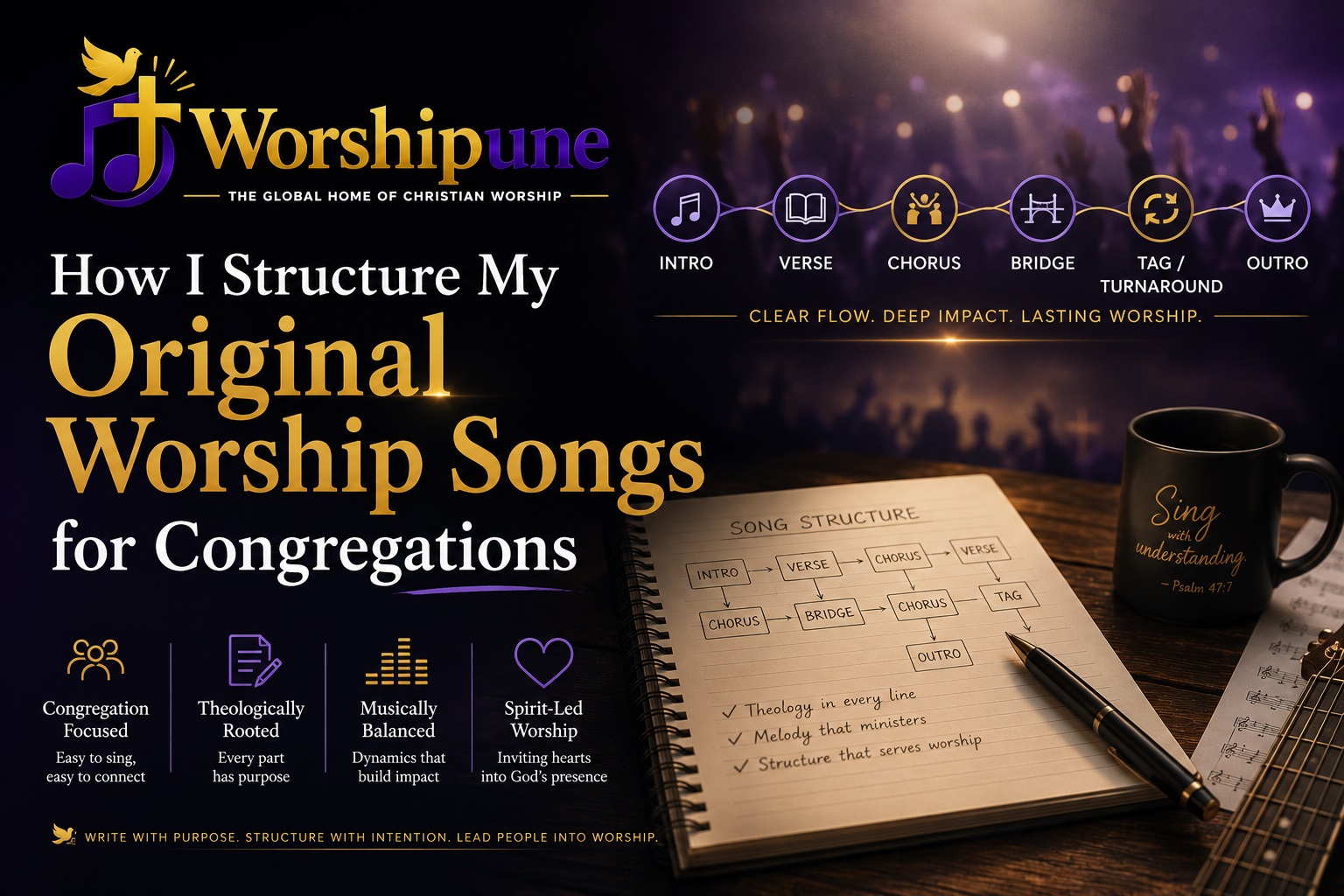
How I Structure My Original Worship Songs for Congregations
A worship song is not a poem set to music. It is not a sermon with a beat. It is not a musical showcase for the songwriter’s talents. A worship song is a carefully designed spiritual journey that takes a group of people from where they are to where God wants them to be. And the vehicle for that journey is structure. The architecture of the song matters just as much as the lyrics and the melody. I have learned — often through painful trial and error in front of real congregations — that the structure of a worship song is just as important as its content. A theologically perfect song with a weak structure will fall flat in a room full of people. A simple song with a powerful, well-crafted structure will carry an entire congregation into the presence of God.
In this article, I am going to show you exactly how I structure my original worship songs for congregations. This is the architecture behind every song I write. It is not the only way to structure a worship song, and I break my own rules when a song demands it. But it is the way that has consistently worked for me across dozens of songs and hundreds of worship services. It is deeply rooted in The Worshipune Way: creating songs that are biblically grounded, singable by real people, and born from personal encounter with God. If you have ever written a song that sounded great in your bedroom but died in the sanctuary, this guide will show you why — and how to fix it.
Why Structure Matters More Than Most Songwriters Realize
When I first started writing worship songs, I thought structure was just a formality. Intro, verse, chorus, verse, chorus, bridge, chorus, outro. Done. I treated it like a template I had to fill in, a container for my brilliant lyrics and melodies. What I did not understand — and what took me years to learn — was that structure is actually a form of communication. The way a song is built tells the listener how to feel, when to lean in, when to release, and when to rise. The structure is the roadmap, and if the roadmap is confusing, the journey is frustrating. If the roadmap is clear, the journey is transformative.
Think about it for a moment. A song that starts loud and stays loud for its entire duration has no dynamic journey. It is a flat line. It might be energetic, but it does not take the listener anywhere. A song with no bridge has no moment of elevation, no climax, no peak experience. A song with three verses and no clear chorus gives the congregation nothing to hold onto, no anchor, no refrain to return to when they need it most. Structure is the invisible hand that guides the worshipper through the song. And if you ignore it, you are leaving one of your most powerful tools unused.
I learned this lesson during one of the most embarrassing moments of my worship leading life. I had written a new song that I was convinced was powerful. The lyrics were strong, drawn from a beautiful passage in Isaiah. The melody was beautiful, with interesting intervals and a compelling hook. But I had structured it with two long verses, a short chorus, another verse, a bridge, and then a final chorus. The sections were unbalanced. The chorus came too late. The energy never built properly. When I led it with my church on a Sunday morning, the congregation looked lost. They could not find the chorus. They did not know when to sing. By the time we reached the bridge, the energy had drained out of the room like air from a punctured tire. After the service, my pastor gently pulled me aside and said, “The song has real potential, but the structure needs work. The congregation could not follow it.” He was right. I went home that afternoon and rewrote the entire architecture of the song. I shortened the verses. I moved the chorus earlier. I rebuilt the bridge. The next time we sang it, the room was completely different. The same lyrics. The same melody. But a completely different experience. That is the power of structure. It can make or break a song.
The Worshipune Song Structure: My Default Framework
Over years of writing, testing, refining, and sometimes failing, I have developed a default structure that I use as my starting point for almost every worship song. I call it the Worshipune Framework, and it is designed to serve the congregation first, the songwriter second. Here it is in its basic form:
Intro → Verse 1 → Chorus → Verse 2 → Chorus → Bridge → Chorus (Final/Modified) → Outro
This is not revolutionary. Many worship songs follow a similar pattern. But the difference is in the details — how long each section is, what function each section serves, how the transitions between sections create momentum, and how the dynamics shift from section to section. Let me break down each element in detail.
The Intro: Setting the Atmosphere
The intro is not just a musical warm-up or a chance for the band to show off. It is the first impression. It is the opening of the door. It tells the congregation what kind of encounter they are about to have. Is this song intimate and personal, inviting them into a quiet conversation with God? Is it celebratory and corporate, calling them to stand and shout? Is it a lament that requires vulnerability and honesty? The intro sets the tone before a single word is sung, and that tone must be congruent with the rest of the song.
I keep my intros relatively short — usually four to eight bars, sometimes up to twelve if the song needs more time to settle. I do not want the congregation waiting too long before they can engage. Worship is participatory, not observational. If the intro drags on for thirty-two bars of instrumental noodling, the congregation has already checked out before the first verse begins.
If the song is intimate, I might use a simple piano or guitar figure with lots of space and silence between the notes. The sparseness creates room for the Spirit to move. If the song is energetic, I might use a full band with a driving rhythm that creates immediate forward momentum. The key is congruence: the intro must match the emotional world of the song. A quiet, reflective intro to a high-energy song creates confusion. A bombastic intro to a gentle song creates whiplash.
I also use the intro to establish the key and the melodic motif that will appear throughout the song. If the chorus has a particular melodic hook, I sometimes hint at it in the intro. This creates familiarity before the congregation even hears the full melody. When the chorus arrives, it feels like coming home to a place they have already visited.
Verse 1: The Invitation into the Song’s World
The first verse is the invitation. It is where I introduce the central theme, the scripture, or the personal story that will carry the song. I keep the melody relatively restrained in the first verse. I do not want to give everything away too soon. The verse should feel like the beginning of a conversation — a gentle knocking on the door, not a battering ram.
Lyrically, the first verse usually sets the scene. If the song is about God’s nearness, the first verse might describe a moment of feeling distant or alone. If the song is about redemption, the first verse might describe the condition before redemption — the brokenness, the shame, the lostness. This creates tension that the chorus will resolve. Without tension, the resolution has no power. A song that starts with the answer feels preachy. A song that starts with the question and moves to the answer feels like a journey.
I also keep the vocal range moderate in the first verse. I want the congregation to be able to sing comfortably from the very beginning. If the song is in the key of G, the first verse should sit in the middle of the range, not pushing toward the top. I save the higher notes for the chorus, where the emotional release naturally belongs. This creates a sense of ascent throughout the song that mirrors the spiritual ascent of worship.
The Chorus: The Anchor of the Song
The chorus is the heart of the song. It is the part that everyone remembers. It is the part that gets sung in the car on the way home. It is the part that comes back to someone in the middle of a difficult night. If the verse is the invitation, the chorus is the destination. It is the truth that the entire song exists to declare.
I follow four strict rules when writing a chorus. First, it must be lyrically simple. One central truth. No complex theology. No abstract concepts. Something a child could understand and a theologian could appreciate. Second, it must be melodically memorable. A hook that sticks after one hearing. A gravitational pull that makes the listener want to return to it. Third, it must be emotionally satisfying. It should feel like release after the tension of the verse. It should feel like the answer to the question the verse posed. Fourth, it must be repeatable. The congregation should want to sing it again. They should feel incomplete if they only sing it once.
The melody of my choruses usually sits higher than the verses. This creates natural lift without requiring the songwriter to do anything clever. The rhythm is often more sustained — longer notes, fewer syllables — which gives the feeling of breathing out, of declaration, of spaciousness. I also make sure the chorus is shorter than the verse. If the verse has eight lines, the chorus has four or six. This creates a sense of focus and urgency. The chorus is the concentrated essence of the song.
Verse 2: Deepening the Story Without Repeating It
The second verse has a crucial job: it must deepen what the first verse introduced without simply repeating it. If verse 1 set the scene, verse 2 advances the narrative. If verse 1 described a problem, verse 2 describes a response, a revelation, or a deepening of the experience. If verse 1 was personal, verse 2 might broaden to the corporate or the eternal. The second verse must feel like a continuation, not a duplication.
Melodically, the second verse usually follows the same pattern as the first verse, but I sometimes make small variations — an extra passing note, a slight rhythmic change, a different harmonic color — to keep it interesting for the listener. The key is that it must still feel familiar enough for the congregation to sing without hesitation. If the second verse introduces a completely new melody, the congregation will stumble. If it is too similar, they will tune out. The sweet spot is recognizable but fresh.
Lyrically, I am careful not to introduce a new theme in verse 2. The theme must remain the same, but the angle changes. For example, in a song about God’s faithfulness, verse 1 might be about His faithfulness in my past — a specific memory of His provision. Verse 2 might be about His faithfulness in the present moment, or His faithfulness on behalf of the whole church, or His promised faithfulness in the future. Same truth, different lens. This creates depth without creating confusion.
The Bridge: The Climax of the Journey
The bridge is the most misunderstood and most underutilized section of a worship song. Many songwriters treat it as an afterthought — a place to throw in a few more lyrics before the final chorus. I treat it as the climax. The bridge is where the song reaches its highest point, emotionally and theologically. It is the moment of greatest intensity, the peak of the mountain, the crescendo before the final resolution.
In my songs, the bridge usually does one of three things. It either shifts perspective (from “I” to “we” or from “You are” to “You always will be”), it introduces a new scripture that elevates the central truth to its highest expression, or it creates a moment of corporate declaration that the congregation can shout rather than sing. The bridge is not filler. It is the fireworks.
Musically, the bridge is where I make the biggest change. I might modulate up a half step to create a sense of ascent. I might drop the instrumentation to just drums and vocals to create intimacy before the explosion. I might introduce a new chord that has not appeared in the song before, creating a moment of harmonic surprise. The goal is to signal to the listener: pay attention, something important is happening. Do not miss this.
The bridge is also where I often push the vocal range higher. If the chorus sits comfortably, the bridge reaches upward. This physical reaching in the voice mirrors the spiritual reaching of the lyric. When the congregation sings the bridge, they are not just singing words. They are stretching toward God. They are reaching for something beyond themselves. The bridge is the moment of desperate faith, of bold declaration, of collective longing.
The Final Chorus: The Landing
After the bridge, the final chorus is the landing. It is not just a repeat. It is the resolution. Everything in the song has been building toward this moment. The tension of the verses, the declaration of the earlier choruses, the climax of the bridge — all of it converges in the final chorus. It should feel inevitable, like the only possible conclusion. When the congregation sings it, they should feel like they have arrived.
I often modify the final chorus slightly to mark it as special. I might add a harmony part that was not there before. I might extend the last line, holding the final note longer. I might repeat the final phrase twice for emphasis. The instrumentation usually reaches its fullest point here — all instruments in, driving rhythm, maybe a key change, maybe additional vocal layers. This is the moment of corporate release. The whole room singing together. The truth declared in unison. The worship experience at its peak.
The outro that follows is usually a gradual fade. I do not like abrupt endings in worship songs. I want the last note to hang in the air, giving the congregation a moment to absorb what they have just sung. Sometimes I repeat the final line of the chorus softly, like a whispered prayer. Sometimes I end on a sustained chord and let it decay naturally. The outro is the exhale after the song’s journey. It is the silence where the Spirit speaks. It is the moment between the amen and the next song.
Dynamic Mapping: Building Energy Throughout the Song
Beyond the structural sections, I also map the energy of the song visually. I think of it as a graph with time on the x-axis and intensity on the y-axis. A well-structured worship song should have a clear upward trajectory, with strategic moments of rest that make the peaks feel higher.
Here is what my typical energy map looks like:
-
Intro: Low energy, atmospheric, inviting. The band is barely playing. The room is settling.
-
Verse 1: Low-moderate energy, intimate, personal. The lead vocal is gentle. The accompaniment is sparse.
-
Chorus 1: Moderate energy, first declaration, the room begins to join in. The band adds layers.
-
Verse 2: Moderate energy, slightly fuller than verse 1, the story deepens. The congregation is engaged.
-
Chorus 2: Moderate-high energy, more confident, fuller instrumentation. The room is singing loudly.
-
Bridge: High energy, peak moment, maximum intensity. This is the moment everything has been building toward.
-
Final Chorus: High energy, sustained, corporate celebration. The whole room is fully engaged.
-
Outro: Decreasing energy, gentle landing, space for reflection. The song dissolves into silence.
This map is not rigid. Some songs call for a different shape. A lament might start low and stay low, with small moments of hope breaking through like light in a cave. A celebration might start high and stay high, with variations in texture rather than volume. But in general, I aim for an upward arc. Worship is a movement toward God, and the song’s energy should reflect that movement. We are not standing still. We are ascending.
The Importance of Transitions Between Sections
Transitions are the connective tissue between sections. A bad transition can make a great song feel disjointed, like a movie with missing scenes. A good transition can make a simple song feel seamless, like a river flowing without interruption. I have learned to spend a surprising amount of time on transitions because they are often the difference between a song that works and a song that stumbles.
I use three types of transitions, and I combine them for maximum effect. First, musical transitions: a drum fill that signals the change from verse to chorus, a piano run that bridges the gap, a guitar riff that creates anticipation. Second, lyrical transitions: the last line of the verse setting up the first line of the chorus. For example, if the verse ends with “I was lost and You found me,” the chorus might begin with “You are the God who seeks the lost.” The lyric creates a bridge between sections. The congregation is carried from one to the other by the logic of the words. Third, dynamic transitions: a sudden drop in volume before the chorus explodes, or a brief pause before the bridge begins. These create anticipation and release. The drop makes the rise feel higher. The pause makes the entrance feel more dramatic.
I have rewritten verse endings five times just to get the transition into the chorus right. It is worth the effort. The congregation may not consciously notice a great transition, but they will definitely feel a bad one. A bad transition creates a bump in the road. A good transition creates a smooth highway that carries the worshipper deeper into the presence of God.
Modulation and Key Changes: When and How I Use Them
I use key changes sparingly. A well-placed modulation can elevate a song to new heights, but an unnecessary one can feel cheap, manipulative, and musically clichéd. My rule is simple: only modulate if the lyric demands it. If the song is building to a declaration that needs to feel bigger than everything that came before, a half-step modulation can serve that moment beautifully. If I am just modulating because I think it sounds impressive or because I heard another songwriter do it, I leave it out. The modulation must serve the message, not my ego.
When I do modulate, I usually do it at the bridge or the final chorus. I modulate up a half step (one semitone). This is the most natural-sounding modulation for worship songs because it creates lift without creating strain. I prepare for it by using a chord in the old key that shares notes with the new key, creating a smooth pivot. For example, if I am in the key of G and modulating to Ab, I might use an Eb chord (which exists in both keys) as the transition chord. The congregation feels the lift without being jarred by it.
I also consider the vocal range carefully. A modulation that pushes the melody too high will cause the congregation to drop out. They will stop singing and start listening. I always test modulations by singing them myself and imagining how they would feel for a room full of non-musicians. If the highest note becomes a strain, the modulation is too much. I either lower the key or skip the modulation entirely. The congregation’s participation is more important than the songwriter’s cleverness.
Testing Structure with Real People: My Three-Phase Process
The ultimate test of a song’s structure is not how it looks on paper. It is not how it sounds in my studio. It is how it feels in a room full of real people. I have a three-phase testing process that I use for every song before I consider it ready for public worship.
Phase 1: Solo Test. I sing the song alone, accompanying myself on guitar or piano. I pay attention to where the song feels natural and where it feels forced. I notice if I am running out of breath, if the transitions feel awkward, if the chorus does not land with the impact I want. I sing it all the way through multiple times. I record myself and listen back. I make notes. I revise. This phase is private and honest.
Phase 2: Small Group Test. I sing the song for three to five trusted friends in a living room or small group setting. I watch their faces. I notice if they look confused at any point. I ask them specific questions: “Could you follow the structure?” “Did the chorus feel like the high point of the song?” “Was there any moment where you lost engagement?” “Could you sing the melody back to me?” Their honest feedback is invaluable. I have rewritten entire sections based on one comment from a small group test.
Phase 3: Church Test. I lead the song with my full worship team in a church service. This is the real test. This is where the theory meets the practice. I watch the congregation. I listen to their singing volume. I notice if they are participating or just listening. I feel the energy in the room. After the service, I get feedback from my pastor, my worship team, and trusted members of the congregation. If the structure does not work in this setting, I go back and revise. I have rewritten the structure of songs after the church test more times than I can count. It is humbling. But it is also how I know the songs I release are truly ready for congregational use.
Common Structural Mistakes I Have Made and Learned From
Let me share the structural mistakes that have cost me the most over the years:
Mistake 1: Too many sections. I once wrote a song with two verses, a pre-chorus, a chorus, a bridge, a tag, and an instrumental break. The congregation could not keep track of where we were. They were lost in the maze. Now I limit myself to five distinct sections maximum. Simplicity is clarity.
Mistake 2: The chorus arrives too late. If the congregation has to wait more than ninety seconds to hear the chorus, they will disengage. Their attention span is limited. I aim to introduce the chorus within the first minute of the song. Give them the anchor early.
Mistake 3: No dynamic variation. A song that is loud all the time feels like shouting. A song that is soft all the time feels like whispering. I need both. I map dynamics deliberately, creating hills and valleys that make the journey interesting.
Mistake 4: The bridge is an afterthought. I used to write the bridge last, when I was tired and ready to be done. The result was weak bridges that felt like filler. Now I write the bridge early, when I am still fresh and inspired. The bridge is the climax. It deserves my best energy.
Mistake 5: Ignoring the outro. I used to end songs abruptly, as if I ran out of ideas. Now I craft the outro as carefully as the intro. The last thirty seconds of a song are what people remember as they walk away. The outro is the final impression. Make it count.
Mistake 6: Inconsistent section lengths. I used to write verses that were twelve lines long and choruses that were four lines long. The imbalance made the song feel lopsided. Now I aim for proportional section lengths. The chorus should feel like the natural center of gravity.
Your Structure Is Your Servant, Not Your Master
I want to close with an important principle that has liberated me as a songwriter. The Worshipune Framework is a tool, not a law. I have broken my own rules many times when a song demanded it. Some of my best songs have unconventional structures that do not follow the standard pattern. But I only break the rules intentionally, not out of ignorance. I know the framework well enough to know when to depart from it, and I depart from it for a reason — because the song’s message requires a different shape.
If you are a new songwriter, I encourage you to master the basic structure first. Write ten songs using the intro-verse-chorus-verse-chorus-bridge-chorus-outro pattern. Internalize it. Feel it in your bones. Understand why each section exists and what it does. Then, once you understand why the structure works, you will have the freedom to innovate. You will know when to add a pre-chorus, when to skip the bridge, when to extend the outro, when to experiment with a non-linear form.
Structure is not the enemy of creativity. It is the container that holds creativity. A river without banks is a flood that destroys everything in its path. A river with banks is a force that irrigates, nourishes, and sustains. Give your songs the banks they need, and watch them become powerful forces for worship.

Rebecca Valley is an independent worship artist and founder of Worshipune, creating original worship music and song stories from Camden, NJ. Every song is written from real moment with Jesus. Connect at hello@worshipune.com


